Amara's Story: A glimpse into the life of a woman who lived 3.2 million years ago
Before the Story
I want to tell you a story. It is a story about an Australopithecus woman named Amara, who lived 3.2 million years ago in the woodlands and grasslands of what is now Ethiopia. She was a hominin but anthropologists like to compare her to modern chimpanzees. She was a member of the lineage that would eventually produce every human being alive today so I don’t think it is accurate or appropriate to compare her to chimpanzees.
The mainstream tells us that Australopithecus was a primitive creature, caught between the ape world and the human world. They want to make us believe Australopithecus was a missing link on the long road of evolution between our common ancestor with chimpanzees and us. I do not see it that way. I see Amara and her people as fully human in their own right, living in communities, building shelters, raising families, and adapting to their world with intelligence and resourcefulness.
Amara lived in a world that was very different from the one we inhabit. It was a world of ancient animals and shifting climates, a world that was on the brink of profound change. I have spent years reading the scientific literature on human origins. I have studied the fossil evidence, the archaeological evidence, and the genetic evidence. And I have come to see Amara and her people in a way that differs from the mainstream narrative.
This is the first in a series of posts that will explore the deep history of humanity. I will share Amara's story, and the stories of the people who came after her. I will explain the evidence that supports my interpretation. And I will challenge the racist assumptions that have shaped the mainstream narrative for over a century.
But first, let me introduce you to Amara. Let me show you her world. Let me help you see her as a person, not a specimen.
Amara’s Story
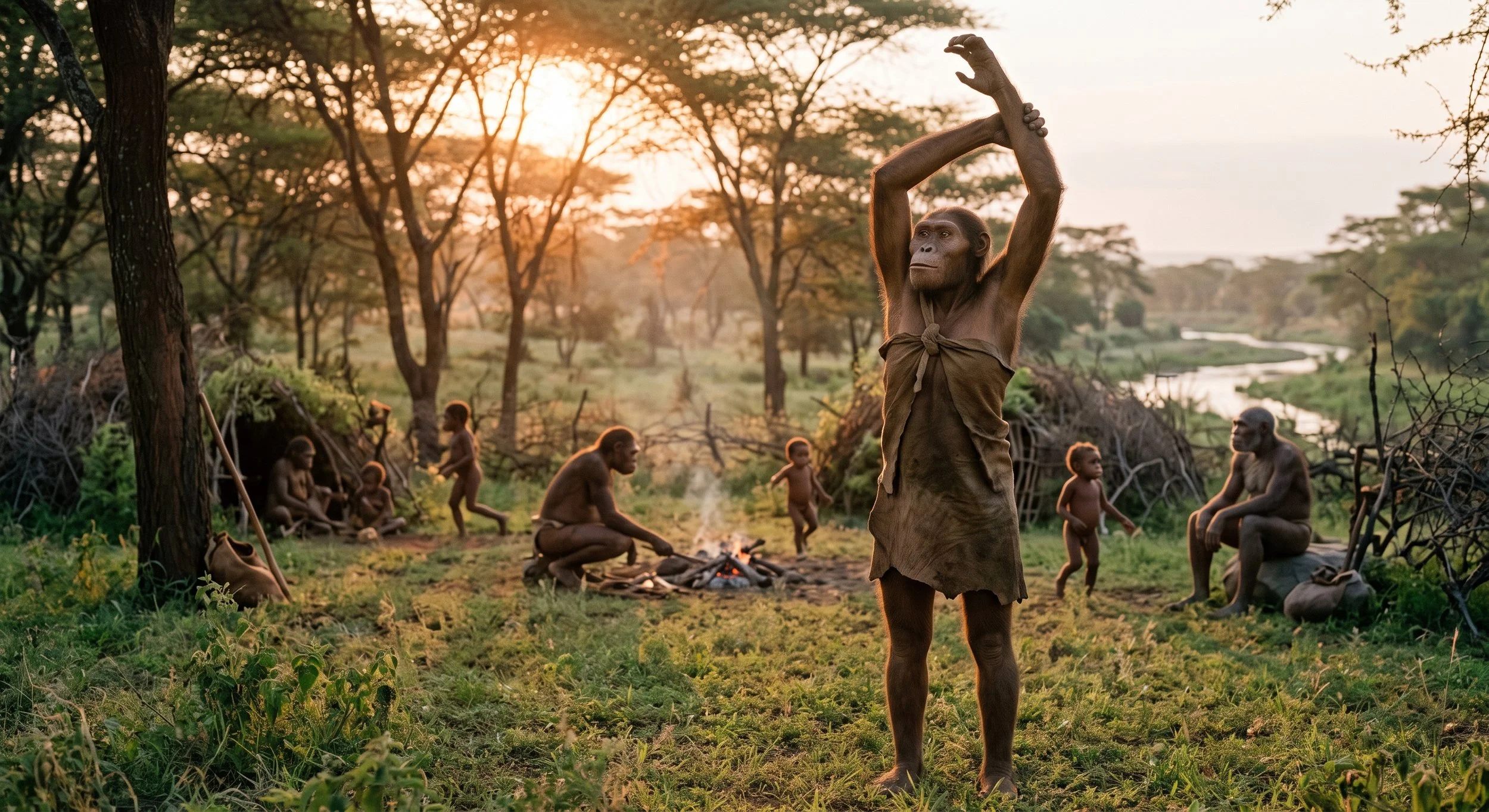
The morning light filtered through the acacia trees and cast long shadows across the ground where Amara's community had built their camp. She woke before the others, as she often did, and lay still for a moment beneath the hide that covered her, listening to the sounds of the woodland coming alive around her. Somewhere beyond the thornbush fence that surrounded the camp, a group of baboons were beginning their daily search for food, their calls carrying across the valley in sharp bursts that echoed off the distant hills. Amara pushed back the covering and sat up, the cool air raising bumps on her medium brown skin. She reached for the hide garment that she wore during the day and wrapped it around her torso, securing it with a knot at her shoulder. The garment was simple, practical, and it protected her from the sun and the wind. Around her, the other members of her community were beginning to stir. She could hear the soft sounds of movement from the nearby dwellings, the murmur of voices, the cry of a child. Amara stood and stretched, feeling the strength in her arms and the familiar balance of her upright stance. She was not tall by modern standards, perhaps a little over four feet, but her body was sturdy and well adapted to her life in the woodlands. Her arms were long, longer than her legs, and her fingers were curved, suited for grasping branches when she climbed. She would climb today, she knew, to gather fruit from the trees that grew along the edge of the woodland. But first, she would join her community for the morning meal, and they would talk about the day ahead, and they would plan where to go and what to do. This was the rhythm of her life, the pattern of her days, and it was a life that had been lived by her people for millions of years.
Amara's Morning
She stepped out of the dwelling and into the open space at the center of the camp, where the embers of last night's fire still glowed faintly in the hearth. A woman named Sina was already there, crouched beside the fire and feeding it small twigs to bring it back to life. Sina looked up as Amara approached and offered a quiet greeting, a soft sound that carried warmth and familiarity. Amara returned the greeting and knelt beside her, holding her hands out toward the growing flames. The heat felt good against her skin, which was cool from the night air.
Other members of the community were emerging from their dwellings now, and the camp was filling with the sounds of morning activity. Children ran between the structures, chasing each other and laughing, their high voices cutting through the deeper tones of the adults. An older man named Turo sat on a flat stone near the edge of the camp, his eyes half closed as he soaked in the first rays of sunlight. He was one of the oldest members of the community, and his knowledge of the woodland was vast. He knew where the fruit trees grew and when they would be ripe, where the bees built their hives, where the streams ran shallow enough to cross. The younger members of the community often sought his advice, and he was always willing to share what he knew.
Amara rose from the fire and walked to the edge of the camp, where the thornbush fence marked the boundary between the familiar space of her home and the wild woodland beyond. She stood there for a moment, looking out at the trees that stretched away into the distance. The woodland was dense in places, with tall trees whose branches formed a canopy that filtered the sunlight into soft green shadows. In other places, the trees gave way to open patches of grassland where the sun beat down directly on the earth. It was a landscape of contrasts, and Amara knew it well. She had spent her entire life learning its rhythms, its dangers, its gifts.
Today, she would climb. The fruit on the trees at the eastern edge of the woodland was ripening, and she wanted to gather as much as she could before the other animals got to it. She would take some of the younger members of the community with her, the ones who were old enough to climb but young enough to still be learning. She would teach them which trees to choose, how to test the branches before putting their weight on them, how to reach the fruit without falling. This was how knowledge was passed from one generation to the next, not through formal instruction but through shared experience, through the simple act of doing something together.
She turned back toward the camp and saw that the others were gathering around the fire, where Sina had begun to prepare the morning meal. There was a pile of tubers and nuts that had been gathered the day before, and a few pieces of meat left over from a recent hunt. It was not a large meal, but it would be enough. The community would eat together, and then they would go their separate ways for the day, some to hunt, some to gather, some to tend to the young or the old. In the evening, they would return to the camp and share what they had found, and the cycle would begin again.
Amara walked back to the fire and sat down with the others. She took a piece of tuber from the pile and bit into it, tasting the earthy sweetness. Around her, the community was talking and laughing and eating, the sounds of their voices blending together into a familiar music. She felt the warmth of the fire on her face and the solid ground beneath her, and she felt at home. This was her community, her family, her world. And she was grateful for it.
Amara's World
The woodland where Amara's people lived was not the dense, closed-canopy forest that we might imagine when we think of the African past. It was a grassy woodland, a mosaic of trees and open spaces that stretched across the floodplain of a great meandering river. The river had carved its path through the landscape over countless millennia, depositing layers of mud and silt that nourished the soil and supported a rich diversity of plant life. Sizeable trees grew along the riverbanks and in the patches of woodland that dotted the plain, their roots reaching deep into the moist earth. Between the trees, grasses and low shrubs covered the ground, creating a landscape of greens and browns that shifted with the seasons.
The climate of Amara's world was warmer and more humid than the arid Afar region of today. The mean annual temperature hovered around 26 degrees Celsius, and the coldest month rarely dipped below 24 degrees. Rainfall was highly seasonal, with a strong summer monsoon that brought between 300 and 800 millimeters of rain each year. The total annual precipitation was roughly 500 millimeters, about twice what the region receives today. The rains transformed the floodplain into a lush, green landscape during the wet months, filling the river channels and creating shallow lakes and wetlands where water birds gathered and hippopotamuses wallowed. During the dry months, the grasses turned golden and the smaller streams shrank to muddy pools, but the great river continued to flow, a lifeline for every creature in the valley.
The animals that Amara knew were not the same as the animals that live in Africa today. The antelopes and gazelles that grazed on the floodplain belonged to species that have long since gone extinct. There were large, pig-like creatures called Nyanzachoerus and Notochoerus, with sprawling tusks and bulky bodies, rooting through the vegetation for tubers and roots. There were early elephants, ancestors of the modern African elephant, whose tusks were shorter and whose ears were smaller. There were three-toed horses called Hipparion, distant cousins of the modern horse, browsing on the shrubs and grasses. And there were rhinoceroses, including an early species called Ceratotherium praecox, whose descendants would eventually become the white rhinoceros.
The predators of Amara's world were formidable. Among the most terrifying was Homotherium, a saber-toothed cat with long, serrated canine teeth and powerful forelimbs built for grappling with large prey. There were also hyenas, not the scavengers that we know today, but large, powerful hunters called Crocuta venustula, who competed with the saber-toothed cats for the same prey. And there were giant otters, Enhydriodon dikikae, creatures the size of modern lions, who lived along the rivers and lakes and hunted fish and small mammals. These predators were a constant danger to Amara and her community, and the thornbush fence around their camp was not merely a convenience but a necessity for survival.
The monkeys and baboons that Amara saw were not the modern species that we know today. The baboons belonged to an ancient genus called Theropithecus, which is represented today by only one living species, the gelada of the Ethiopian highlands. The Theropithecus that lived alongside Amara were large and powerful, with massive jaws and teeth adapted for eating grasses and seeds. There were at least two species present, including Theropithecus oswaldi and Theropithecus darti, and they were among the most abundant primates in the landscape. They lived in large troops, foraging together on the open grasslands and retreating to the trees for safety at night. Their calls, a deep, booming chorus, would have been a familiar sound to Amara's people, a sound that signaled the presence of other creatures sharing the same world. There were also smaller monkeys, including Parapapio, a primitive baboon-like creature, and Cercopithecoides kimeui, a large colobine monkey that fed on leaves and fruit in the woodland canopy.
Amara's people also had cousins in the broader hominin family who lived in the same region. There were the robust australopiths, whom they called the Robust Ones, with their massive jaws and enormous teeth, adapted for chewing tough plant materials. They shared the landscape with Amara's species, sometimes competing for food, sometimes avoiding each other, but always part of the same extended family. The forests and woodlands of the Afar were home to multiple species of hominins, each with its own way of life, its own rhythms and routines, its own place in the web of life that connected them all.
The chimpanzees and gorillas that we know today were not part of Amara's world. Their ancestors, the proto-chimpanzee and proto-gorilla lineages, had diverged from the hominin lineage millions of years earlier, but their fossil remains from this period are virtually absent from the record. Paleontologists have found no convincing fossils of early chimpanzees or gorillas in the Pliocene deposits of East Africa, and the reason may be that these apes lived in the dense rainforests of west and central Africa, environments where fossils do not easily form or survive. The dry, open woodland of the Afar was not their home, and they were not Amara's neighbors.
The world that Amara inhabited was a world in transition. The climate was becoming drier, the grasslands were expanding, and the forests were shrinking. The great river still flowed, but it carried less water than before. The animals that depended on the woodland were slowly being replaced by animals that preferred the open savannah. And Amara's people, with their upright stance and their clever hands and their complex communities, were adapting to the changing landscape in ways that would shape the future of their lineage.
Amara's Day
The sun had climbed higher now, and the camp was fully awake. Amara walked with Sina and two of the older children toward the eastern edge of the woodland, where the fruit trees grew thickest. Each of them carried a long stick, cut from a young acacia and hardened over fire, with a sharpened point at one end. These sticks served many purposes. They could be used to dig for tubers, to knock fruit from high branches, to probe the mud of the riverbank for hidden roots, and, if necessary, to drive off a predator that came too close. The people of Amara's community had been making and using such tools for as long as anyone could remember, though they did not shape stone into knives or scrapers the way their descendants would. Their tools were simple, but they were effective, and the knowledge of how to make them was passed down from one generation to the next with care.
As they walked, Amara kept her eyes moving across the landscape. She knew this woodland the way she knew her own hands. She knew which trees produced the sweetest fruit and when the fruit would ripen. She knew where the ground was soft enough to dig for tubers and where it was too rocky. She knew the tracks of the animals that shared this world with her people, and she could read them like a story. A set of antelope tracks in the mud told her that a herd had passed through recently. A pile of dung told her that a rhinoceros had been nearby, perhaps an hour before. A scattering of feathers told her that a hawk had caught a bird in the tall grass. The landscape was a book, and Amara had learned to read it.
The predators of this world were never far from her thoughts. During the day, the great cats and the hyenas were cautious. They rarely attacked a group of hominins who were alert and armed with sticks. The people were not easy prey. They walked upright, which made them look larger than they were. They carried weapons. They stayed together. The predators had learned to respect them, just as the people had learned to respect the predators. It was a relationship of mutual caution, a balance that both sides understood.
At night, however, the balance shifted. The darkness gave the predators an advantage, and the people retreated behind their thornbush fences, where fires burned through the night to keep the hunters at bay. Sleep was never entirely peaceful. There were always sounds in the darkness, always the sense that something was moving just beyond the firelight.
The river and the lakes were a source of food, but they were also a source of danger. The water was home to crocodiles, huge reptiles that could drag a person under in an instant. There were also hippopotamuses, massive animals with tusks and tempers, who lived in the shallows and could overturn a small boat or crush a person with a single bite. The people of Amara's community probably did not swim. Their bodies were not built for it, and the water was too dangerous. But they were resourceful. They fished from the shallows, using their hands to catch small fish in the quiet pools, and they gathered shellfish and water plants from the muddy edges. They knew which parts of the river were safe and which were not. They knew the habits of the crocodiles and the hippos, and they avoided the places where the animals gathered.
The children who walked with Amara were learning all of this. They watched her as she chose a tree and began to climb, her curved fingers finding purchase on the rough bark. They watched her as she tested a branch before putting her weight on it, a habit she had learned from her own mother. They watched her as she shook the branch and sent a shower of ripe fruit tumbling to the ground. The children gathered the fruit and put it in the hide bags they carried over their shoulders. They were learning the same lessons that Amara had learned, passed down through countless generations. And one day, they would teach these lessons to their own children, and the knowledge would continue, carried forward through time like a thread that connected the past to the future.
Afterward - A Note
This is a work of imagination, but it is grounded in the fossil and archaeological evidence. The environment, the animals, the tools, the shelters, the community structure, all of it is based on what we know from the scientific record. Where the evidence is silent, I have used my best judgment to fill in the gaps, always with an eye toward what is plausible and what respects the humanity of the people I am describing.
In the posts that follow, I will explain the evidence in more detail. I will introduce the African Large Low-Shear-Velocity Province and the Reversed Flux Patches it generates. I will explain how cosmic radiation penetrates the atmosphere during geomagnetic excursions and how it damages DNA. I will show you how the fossil record documents the sudden appearance of new phenotypes during radiation windows. And I will argue that the framework I am presenting explains the pattern of evolutionary leaps in ways that the mainstream models cannot.
I will also dismantle the racist pseudoscience that has infected anthropology for centuries. I will expose the skull collectors and the eugenicists who founded the discipline. I will show how their assumptions continue to shape the questions that researchers ask and the conclusions that they reach. And I will argue that the phenotypes we recognize today are recent mutations, not ancient adaptations.
This is a big project. It will take time to lay it all out. But I am committed to doing it right. I will present the evidence clearly and honestly. I will acknowledge the limits of my knowledge. And I will change my mind if the evidence demands it.
Thank you for reading. I hope you will join me on this journey.
