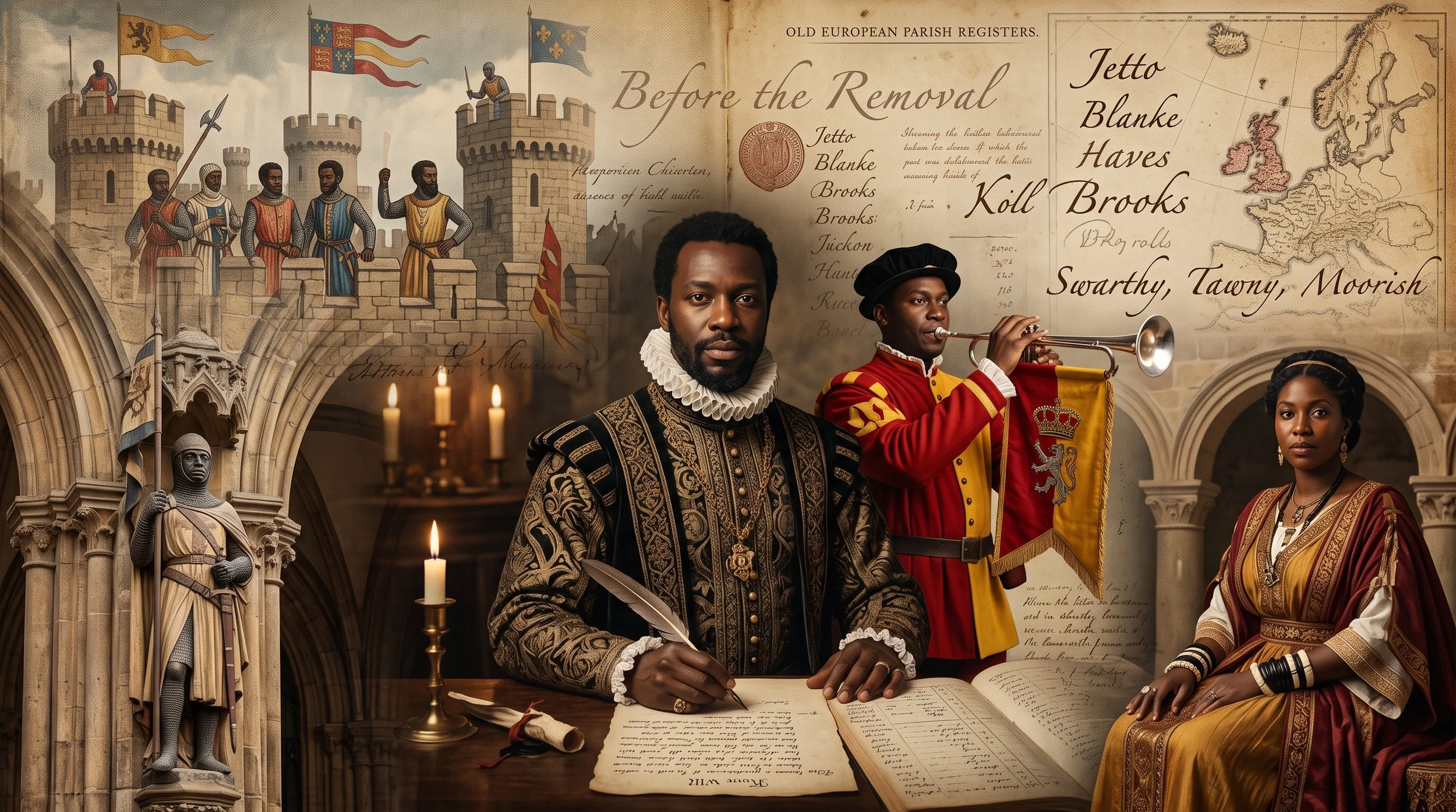
Article 1: Before the Removal: The Black Nobility of Indigenous Europe
The written record of Europe opens with Black people in it, and it opens with Black people at the top. The earliest named individuals in the British and Irish archives are Black people who held wages, land, and standing. The earliest images of named individuals are Black people in fine clothes. The earliest records of property, literacy, and civic participation include Black people by name. This is the baseline, and the story of what happened in the 1500s and 1600s is the story of how that baseline was dismantled.
The Terminology of the Records
Before going further, the reader needs to know the words that the records themselves used. These are the terms that appear in parish registers, wills, state papers, and court documents from the sixteenth and seventeenth centuries. They are not the words we use today, and understanding them is essential to reading the evidence correctly.
Swarthy
The Oxford English Dictionary defines swarthy as describing a person’s complexion or skin color as “(relatively) dark in colour; brown, olive-coloured, or tanned” . The word entered English in the 1570s, and the earliest recorded use, from 1572, is the phrase “swarthy blacke” . It comes from the Old English sweart, the same root that gives the Dutch zwart and the German schwarz, both of which mean black. When a record from the 1500s or 1600s describes someone as swarthy, it is describing a Black person.
Tawny
Tawny entered English in the fourteenth century from the Old French tané, meaning the brownish-yellow color of tanned leather . In colonial British English, the word came to mean “brown-skinned person,” a usage recorded from the 1650s . The phrase “tawny Moor” was used to distinguish a brown-skinned Moor from a “blackamoor,” and both terms referred to Black people .
Moorish
Moorish was a synonym for swarthy. The word “Moor” and “blackamoor” were used interchangeably with “Negro” and “Ethiopian” in the period to describe Black people. In his 1600 translation of Leo Africanus, John Pory described the “principall nations” of Africa as “the Africans or Moores, properly so called; which last are of two kinds, namely white or tawnie Moores, and Negros or black Moores” . The Moors were described in European texts of the period as Black, swarthy, or tawny in skin color.
Blackamoor
The word “blackamoor” is a compound of “black” and “Moor” . It was the name used by English people to describe dark-skinned people. In 1596, Elizabeth I’s privy council authorized the transport of “blackamoors” from the realm, and five years later a merchant complained that “great numbers of Negars and Blackamoors” had “crept into this realm” . The term was used in state papers, household inventories, and portraits.
These are the words that the English records actually used. When a clerk wrote “swarthy” or “tawny” or “blackamoor,” he was describing a Black person. The records did not use the word “African” in the way we use it today, and they did not distinguish between Black people from different parts of the world. They described skin color, and skin color meant Black.
The Original People of Europe
The earliest populations of Britain, Ireland, and Europe were Black. Cheddar Man, whose skeleton was found in Gough’s Cave in Somerset, lived about ten thousand years ago. When his DNA was sequenced in 2018, the results showed a man with dark skin. He belonged to the people who repopulated Britain and Ireland after the last ice age, and that population carried dark skin across the whole of Europe for thousands of years. La Braña 1, found in Spain, and Loschbour, found in Luxembourg, carry the same ancestry. These are not fringe findings. They come from peer-reviewed sequencing of ancient genomes, and they establish that the ancestral European population was Black.
The Roman period adds detail. The Ivory Bangle Lady, buried in York in the fourth century with jet and ivory bangles, glass beads, and a bone mount, was buried with the grave goods that mark high status. Skeletal analysis of her skull showed Black ancestral traits, and isotopic testing of her teeth indicated she grew up in a warm, coastal climate. She was a Black woman of high status in Roman York, buried with jet from Whitby and ivory from North Africa.
The medieval period preserved Blackness in its own way. Saint Maurice, the Roman soldier venerated across Europe, was depicted as a Black man in manuscripts and sculpture from the tenth century onward, and he became the patron saint of Magdeburg in Germany. The Arthurian tradition carried Morien, the Black knight, in a thirteenth-century Dutch romance, and the Black Madonnas of Europe, from Chartres to Montserrat, preserve a devotional tradition that centers a dark-skinned mother.
The Royal Households Were Black Households
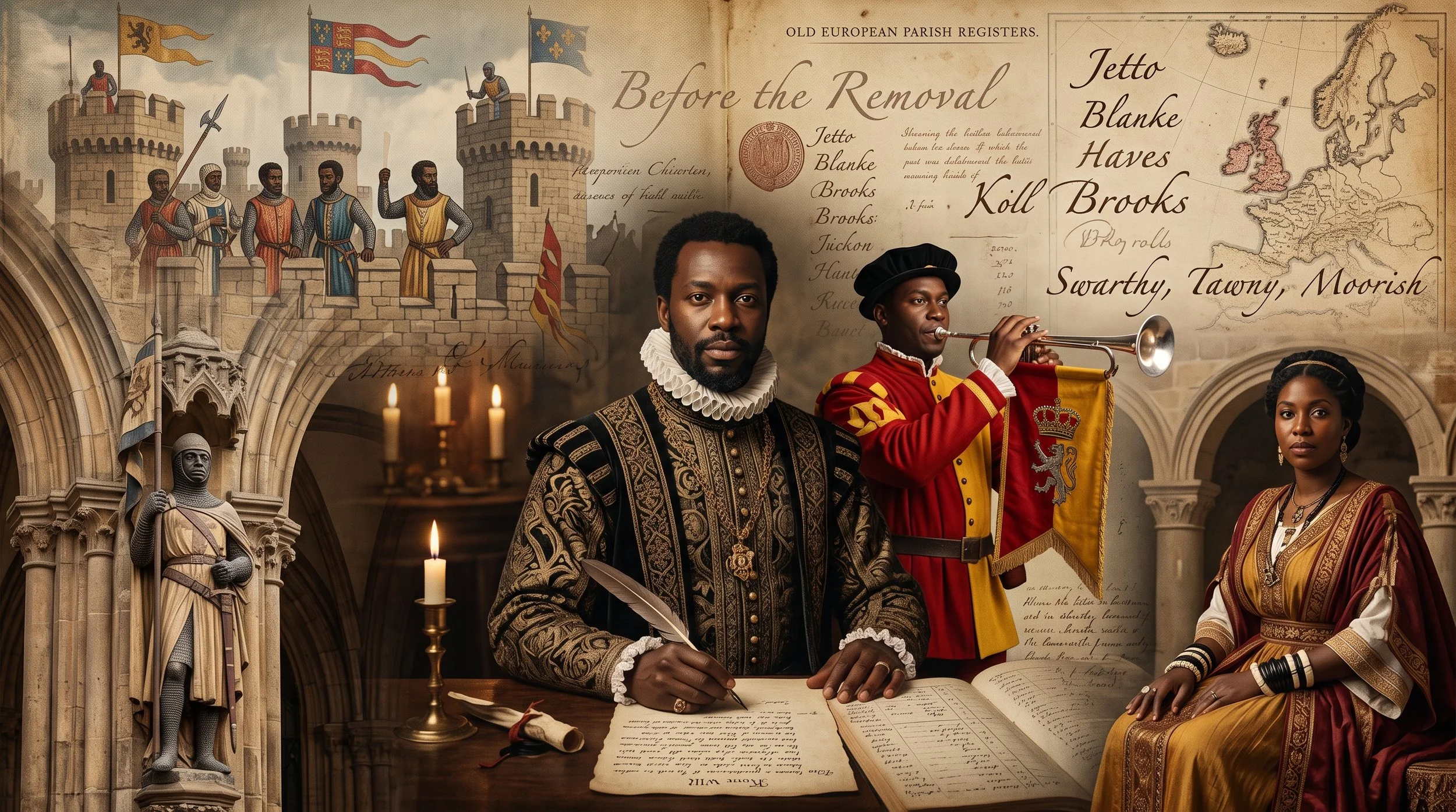
Black Nobility of Europe
John Blanke is the first named Black person in the English royal record, and he was not a servant. He was a trumpeter to Henry VII and Henry VIII, paid at a rate above the standard for Crown service, honored at the funeral of one king and the wedding of the next, and recorded twice in the Westminster Tournament Roll of 1511, a sixty-foot manuscript held by the College of Arms. That image is the earliest portrait of a named Black person in Britain, and it shows a man in the livery of the court, mounted, in the ceremonial life of the kingdom. He petitioned the king for a pay raise and received it.
The Scottish court preserved the same pattern. James IV employed Black musicians and entertainers, and the Scottish Treasury recorded payments to Black troubadours throughout his reign. Two young women referred to as the Moorish lassies arrived at Edinburgh Castle in 1504 and lived as free people of the court. Catherine of Aragon arrived in England in 1501 with Black attendants in her household, and Black musicians and dancers performed at the court of Elizabeth I.
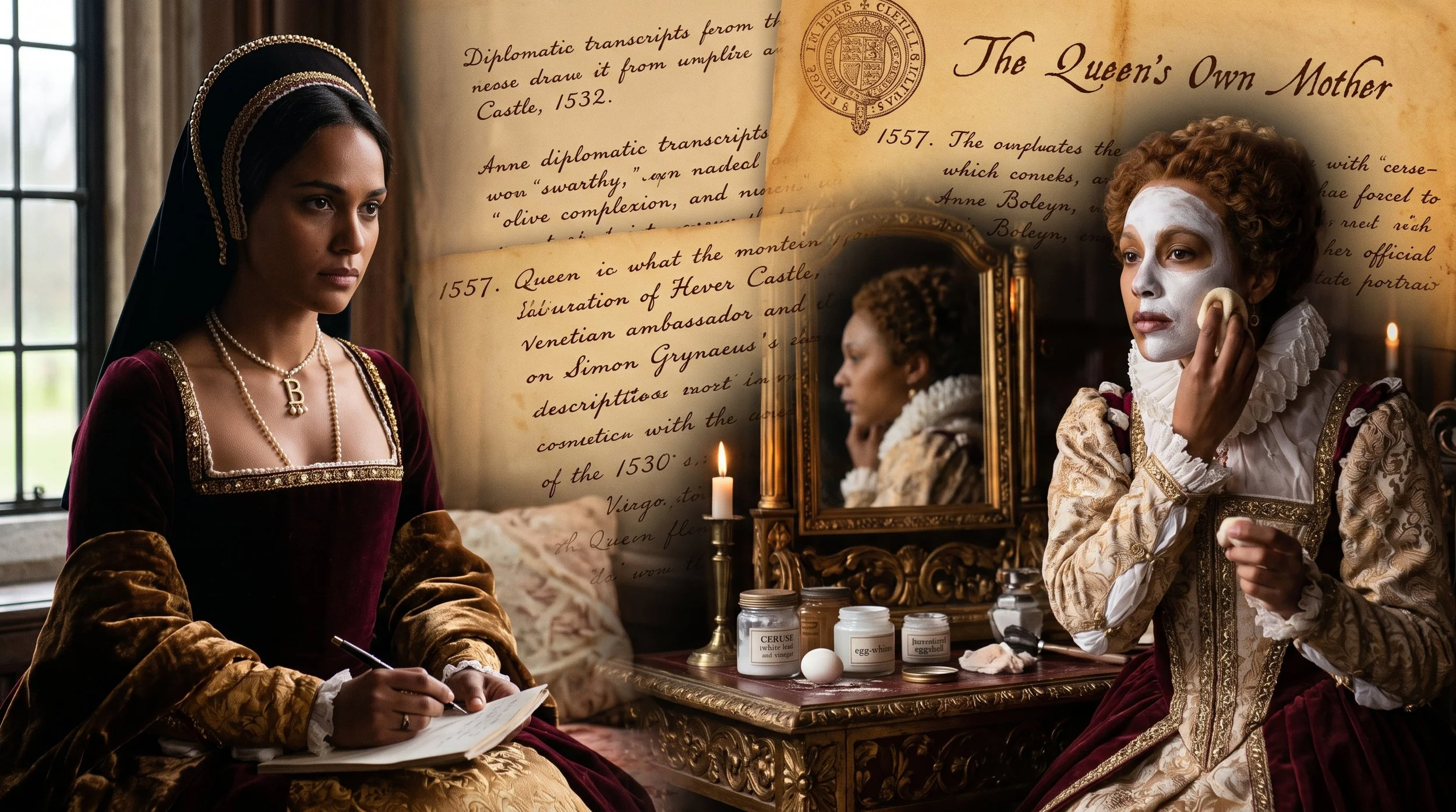
The Queen’s Own Mother
Anne Boleyn and Queen Elizabeth I
The removal did not happen from the outside against a population that had no connection to the throne. It happened from within a royal line that was itself described as Black. Anne Boleyn, the mother of Elizabeth I, was described by the Venetian ambassador who saw her in 1532 as having a swarthy complexion and eyes that were black and beautiful. Simon Gryneaus, a Swiss theologian writing in 1531, described her as being of a rather dark complexion. These were not hostile Catholic sources writing decades after her death. They were eyewitnesses writing during her lifetime. Anne Boleyn was a Black woman, and she was the Queen of England. Her daughter inherited that complexion.
Giovanni Michiel, writing to the Venetian Senate in 1557, described Elizabeth I as being tall and well-formed, with a good skin, although swarthy. The same description appears again in 1557, noting she had a beautiful hand and fine eyes, but that her skin was swarthy.
Elizabeth’s biographers have noted that she had a swarthy, ‘olive’ complexion like that of her mother, and that she made a habit of whitening it with a lotion made up of egg-whites, powdered eggshell, poppy seeds, borax and alum to make her face appear white and luminous. Later in life, she used ceruse, a paste of white lead and vinegar, which thinned her skin, rotted her teeth, and caused the hair loss visible in her later portraits. The ghoulish white mask was not her natural face. It was the face she manufactured to erase her mother’s.
The woman who issued the proclamations against the “Blackamoores” was herself the daughter of a woman described as Black. The woman who authorized the transportation of Black people out of England was herself trying to whiten her own skin to hide the Blackness she had inherited from her mother.
The Landowners
Henry Jetto held land in Worcestershire. He was baptised at St Martin’s Church in Holt in 1596, and the city records describe him as a Blackamoor. He held the rank of yeoman, which required land worth at least forty shillings and carried the right to vote in local elections. He wrote and signed his own will on 20 September 1626, and the document shows he left goods worth £17, 15 shillings, and 8 pence, the equivalent of more than £2,000 today. He was literate, propertied, and civic. He was a Black landholder in England.
The Visual Record
The statues and paintings that depict Black people in fine clothes holding gold cups are evidence, not curiosities. They survive across Europe, and they were altered.
Saint Maurice was a Roman soldier from Thebes, venerated across Europe, and from the tenth century onward he was depicted as a Black man in manuscripts and sculpture. The statue of him in Magdeburg Cathedral, carved in the thirteenth century, shows him as a Black knight in full armor, standing guard as the cathedral’s gatekeeper. He became the patron saint of Magdeburg, and German rulers adopted him as their patron. Later restorations and reproductions lightened him.
The Black Madonnas of Europe, from Chartres to Montserrat, preserve a devotional tradition that centers a dark-skinned mother. Some were darkened in devotion and later lightened in restoration. The practice of whitening Black figures in European art is documented, and it is one of the mechanisms by which the visual record was rewritten.
The tapestry known as Wild Men and Moors, made in Germany around 1440 and now held by the Museum of Fine Arts in Boston, depicts a battle between giant wild men clothed in forest products and the civilized defenders of a castle. The wild men have unkempt hair and beards and prominent fangs, and they attack with sticks and stones. The defenders of the castle are Black, and they fight with bows and arrows from a fortified position. Their king, queen, and princess watch from the keep while heralds call for assistance. The Black defenders inhabit the castle. The pale wild men come from the forest as forces of savagery.
In the Cantigas de Santa María, commissioned by Alfonso X of Castile in the thirteenth century, Cantiga 185 depicts three Black soldiers defending the castle of Chincoya against an attacking force. The miniature shows them in military garb, positioned on the walls, fighting to protect the fortress. They are defenders of institutional power, and the image places them inside the castle rather than outside it.
The Parish Registers and the Broader Record
Miranda Kaufmann documented over 360 Black people living in Britain between 1500 and 1640, and the majority are not recorded as having a master or mistress. The parish registers record Black people being baptised, married, and buried, and the subsidy rolls show Black property holders. The records that survive are a fraction of what once existed.
The medieval legends of Ireland preserved the memory of Black people who were there before the later arrivals. The Formorians, described as fierce sea-pirates with black skin and curly hair, are said to have arrived in Ireland in the first century BCE. The Black Fomorians, the Partholonians, the Nemedians, the Firbolgs, and the Tuatha De Danann all appear in the Irish origin traditions as peoples who inhabited the island before the Gaels.
Why This Matters
Black people were indigenous to Britain, Ireland, and Europe. They held land, paid taxes, voted, served in the households of kings, and were buried with the grave goods of high status. They were literate, propertied, and civic. They had names, and they kept them.
The pale-skinned populations that came to dominate Europe arrived in waves from the steppe, the Caucasus, and Siberia, and the societies they built were, for centuries, primitive in hygiene and literacy by the standards of the Black and Moorish civilizations they encountered. The Black people who were already here were the targets of a removal that began with proclamations and ended with transportation.
The removal did not begin in a vacuum. It began against a population that had been here for thousands of years, that held land, and that carried names. The names are the thread that connects John Blanke and Henry Jetto to the Brooks and Green and Tennyson families of Jamaica and Grand Cayman.
The next article follows the whitening of the art and the erasure of Black nobility from the written record.
Andrea Brooks is an independent researcher and writer challenging the racist foundations of anthropology, history, and science. She is the creator of the Parrhesia Project on Substack and Medium, the Polymath's Parrhesia Podcast, and the Rumble livestream series Let's Debunk the Bullshit. She writes about human origins, phenotypic diversity, and the erasure of Black Indigenous people from the historical record.

Andrea Brooks
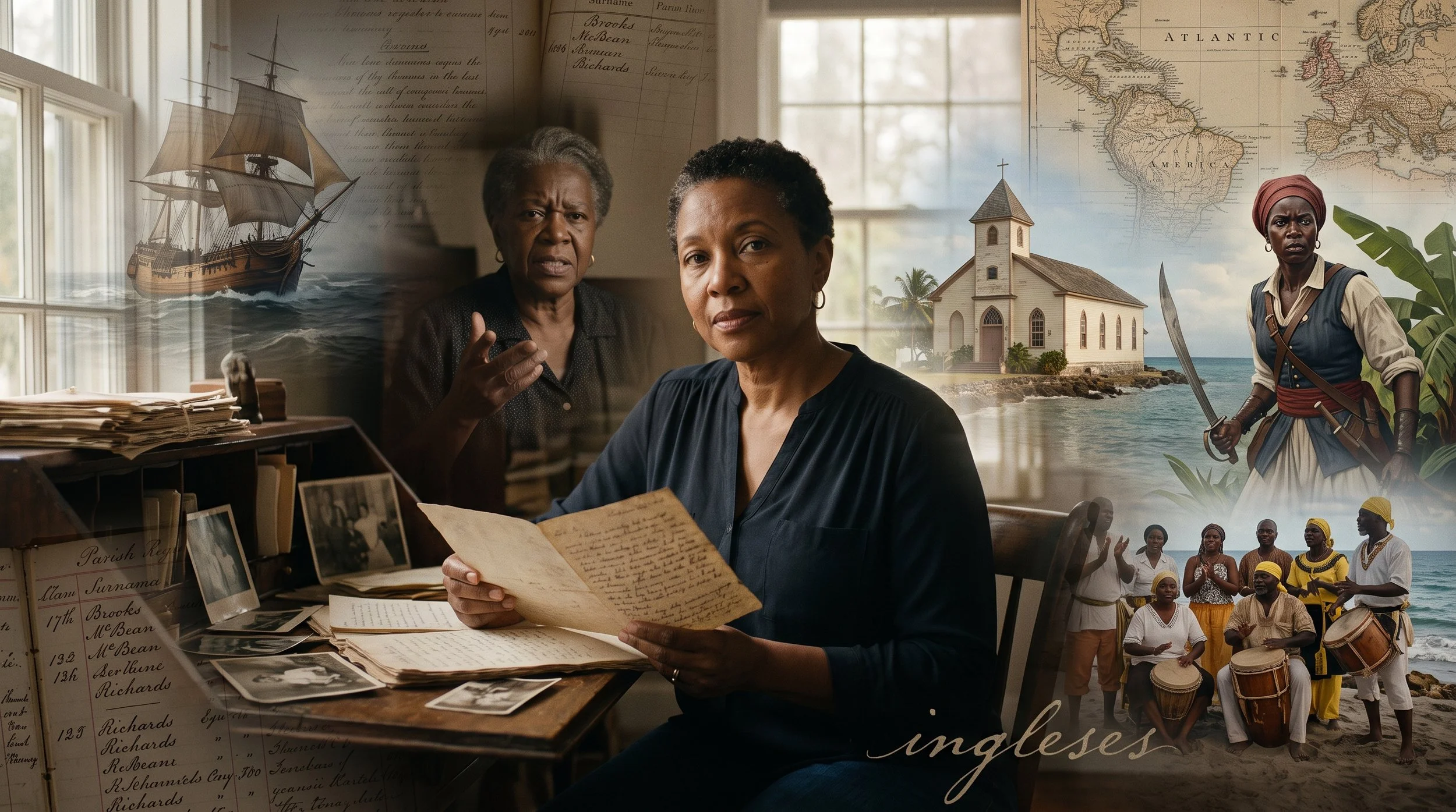
Why I Went Looking for the Ingleses
There is a word my mother uses for us, and she uses it with a finality that forecloses further discussion. Ingleses. The word is Spanish, and it means "English." Her diminutive version, inglesitos, means something closer to "little English ones," and she says it the way a person names a family trait that has been passed down so long that no one remembers where it came from.
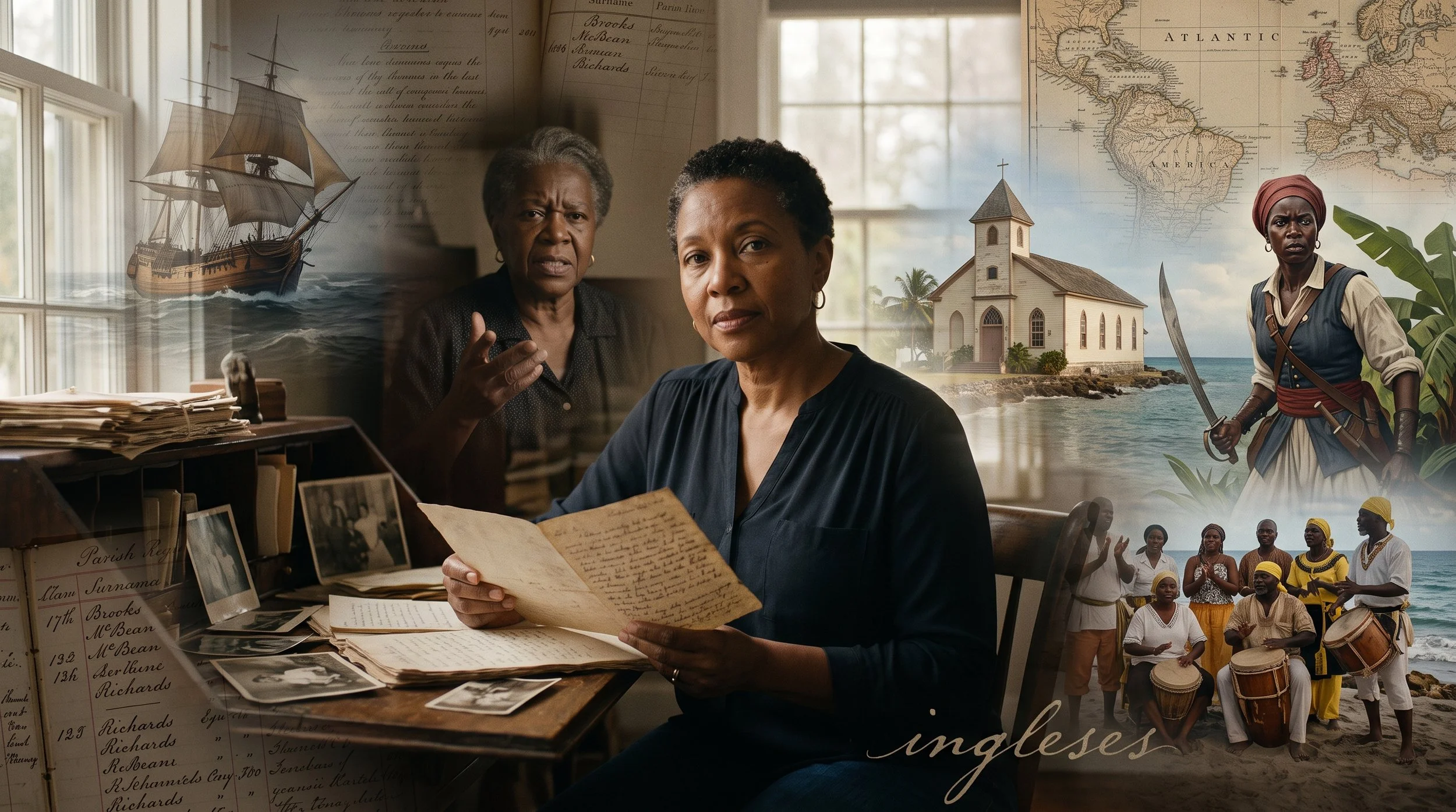
When I told my mother I suspected we carried Garifuna ancestry, she pushed back hard, insisting that her father had spoken Garifuna but he also spoke many other languages and that our family's identity was settled. Ingleses, she said. That word, and the resistance that came with it, stayed with me for years.
I have five children, and two of the three fathers are Garifuna. When I began digging into my own lineage, I half expected to find that I was Garifuna myself. I confess I wanted it. My mother and her Jamaican mother had always spoken about the Garifuna with a contempt I found repellent, and that contempt, rather than pushing me away, drew me toward the people it was aimed at.
The Garifuna are a Black Indigenous people of the Americas who held onto their language and their ceremonies through centuries of colonization, and their survival is one of the great refusals in Caribbean history. Their language is Arawakan which is indigenous to the Americas, not African. Their origins lie in the islands and along the Central American coast. I wanted to belong to a story like that.
My mother's father was born on the Bay Islands of Honduras in 1893, when his mother was sixteen years old. No father is named on the record. My mother says he spoke Garifuna. That detail has never left me, and I still suspect that somewhere in the tangled branches behind him there is Garifuna ancestry.
But something else was nagging at me, and it had to do with the surnames.
A friend of mine from Brandeis, a Black Jamaican named James McBean, greeted me the first time we met with a question I did not understand. The first thing he said to me was, "You look like a Maroon. Are you Maroon?" I still get chills when I think about it. At the time, I had no idea what he meant. Now I know a lot more about the Jamaican Maroons and about Queen Nanny. She was an Obeah practitioner and a fierce warrior who fought the British and won. She beat them so badly that they were forced to sign treaties with the Maroons. Queen Nanny is one of the ancestors who guides me.
Something that always stood out to me was James’ surname. McBean is Scottish. If the standard story were true, that Black people simply took the surnames of the people who enslaved them, then every person on a given plantation should carry the same name, and James should have carried the name of a Jamaican planter rather than a Scottish one. When I began pulling the registers, that uniformity never appeared. Names varied within families, across households, and across generations. The assumption that Black people received their surnames from enslavers is a colonial reflex, and the documents do not bear it out.
So I went looking, and what I found reframed everything I thought I knew about where we came from. Black people were present in Britain and Ireland and across Europe for centuries before the so-called transatlantic slave trade, and their presence was not confined to the servant class. They held land, paid taxes, and voted in local elections. When the state decided to remove them, it did so with proclamations and transportation orders that swept up the poor, the imprisoned, and the undesirable alongside them.
The 1600s saw a campaign of removal that sent thousands of English, Irish, and Scottish prisoners to Barbados, Jamaica, and the other islands, and Black Indigenous Europeans were among them. The records that documented this traffic called them prisoners, a label that erased where they came from and who they were. Other records from the same century described Black people as swarthy, tawny, and Moorish, words that carried the meaning of Blackness without using the word Black.
My family's surnames are Brooks, Green, Tennyson, Richards, Martin, and Iraheta. English, Welsh, Irish, and Basque. They are older than the plantation, and they are older than the trade that the standard story insists gave them to us.
My mother calls us ingleses which means English. That word is a memory, and it is a memory of a history that the records were built to obscure. It is the Caribbean memory of the prisoners who were shipped to the islands, of the Black Indigenous Europeans who were transported and enslaved and written out of the ledger, of the people who kept their own names when the system tried to take them.
This series is about the real history of the transatlantic slave trade. We were taught that Africans were captured and shipped across the Atlantic and enslaved in the Americas. They want us to believe that all of the Black people in the Americas today are descendants of people who were captured in Africa and trafficked across the Atlantic but that is a lie. The lie is told to obscure the real history of two distinct groups of Black people and deprive us of land rights. The two groups are Indigenous Black people of Europe and Indigenous Black people of the Americas.
You are probably already doubting the validity of what I am claiming so I will give you one piece of evidence to start with. When Columbus arrived in the Americas there was a distinction made between Black people from Africa and the Black people who were already here. Old Spanish and Portuguese records mention Negros de la Tierra which translates to Blacks of the Land and refers to the Indigenous Black people who had been in the Americas for thousands of years. They also mention Negros de Guinea which translated to Blacks of Guinea. Guinea is what they called Africa so they were basically saying Black people from Africa. I want you to remember that term for Africa, Guinea, because it will come up again when I tell the history of the Indigenous Black people of the Americas. Eventually I will tell the stories of both groups, Indigenous Black people of the Americas and Indigenous Black people from Europe, but I am going to start with my history first.
The story begins with the Black people who lived in Britain and Ireland in the 1500s, before the trafficking began. It moves through the proclamations of Elizabeth I and the transportation campaigns of Cromwell. It follows the ships to Barbados and Jamaica, and it traces the Black Irish, Black Scottish, and Black Britons who survived there and in Cayman. It examines the surnames that Black people kept, the names that were theirs, and the labels that the records used to hide them. It ends, for now, with the Garifuna, the Black Indigenous people of the Americas who are still here, and with my own family, and with the word ingleses. We will also examine the history of the Black Indians from Massachusetts where I was born and raised because that history feels very personal to me as well.
Back to what started this journey of exploration for me. My mother pushed back when I said Garifuna. She insisted we are ingleses. I am not going to argue with her. I am going to follow the records and the names and the history wherever they lead, and I am going to tell the story that the colonial archive tried to bury. The contempt for the Garifuna that I grew up hearing is itself a colonial inheritance, passed down through generations that did not know where it came from. The word ingleses is a memory of survival, and so is the Garifuna refusal to disappear.
This is why I went looking and I am going to share what I found. This is where the story begins.
Andrea Brooks is an independent researcher and writer challenging the racist foundations of anthropology, history, and science. She is the creator of the Parrhesia Project on Substack and Medium, the Polymath's Parrhesia Podcast, and the Rumble livestream series Let's Debunk the Bullshit. She writes about human origins, phenotypic diversity, and the erasure of Black Indigenous people from the historical record.


The Provocative Parrhesiatic Polymath

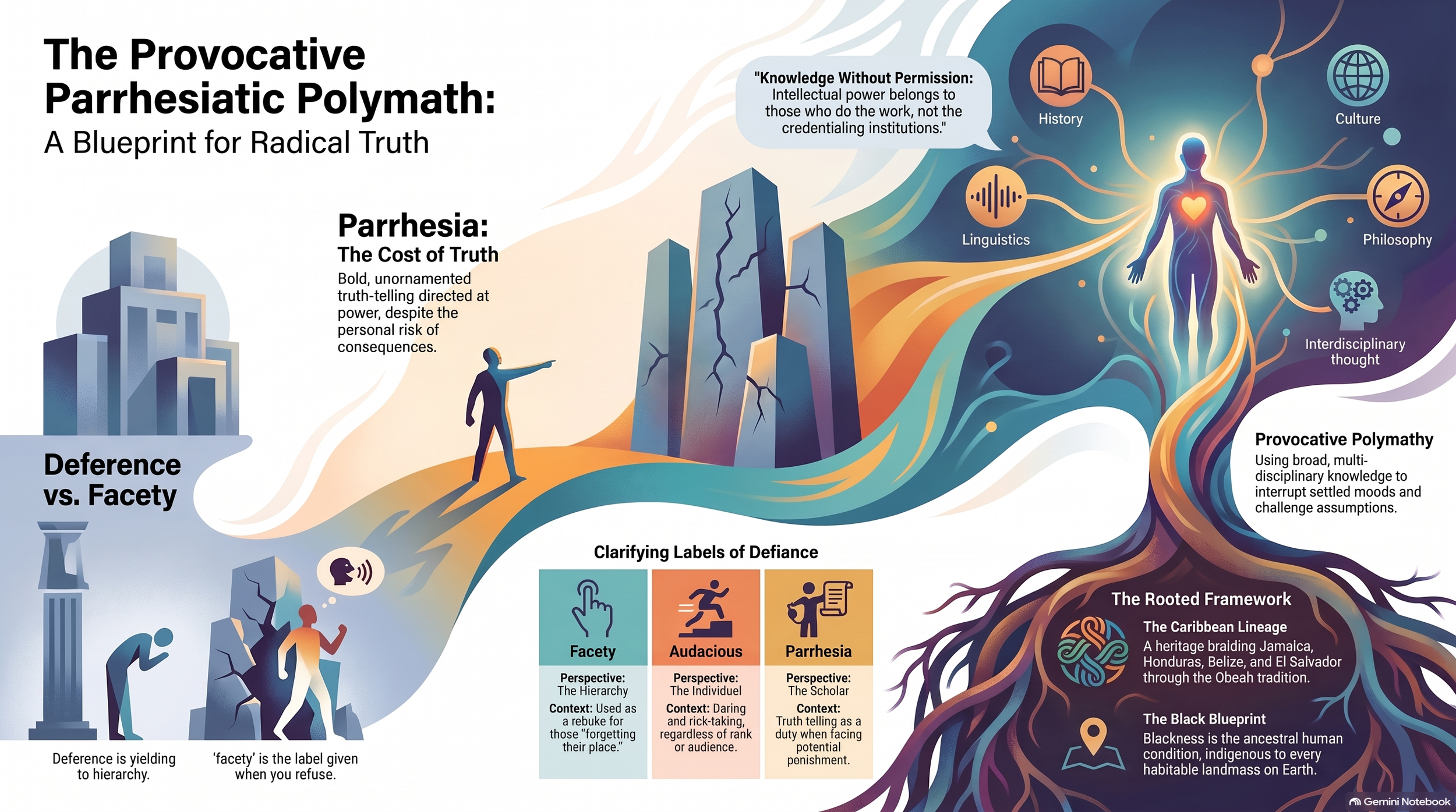
There is a word in Jamaican patois that gets used to put people back in their place. The word is facety. You hear it aimed at a child who talks back to an elder, at a young woman who questions a man twice her age, at anyone whose mouth has moved ahead of the position they were assigned. The word carries the flavor of facetious, and it lands as a rebuke, a way of saying that the person speaking has forgotten where they belong. What the word describes depends entirely on who is holding the power to apply it. The same sentence that gets a child called facety gets a professor called incisive. The behavior stays constant while the label swings, and the swing tracks the hierarchy, never the words.
Start there, because that single word holds the whole architecture of what a Provocative Parrhesiatic Polymath is and why the phrase carries weight.
Deference
Deference is the act of yielding to another person's judgment, authority, or preference, granting them the higher position in a hierarchy. It can be offered willingly, as a form of respect for someone whose wisdom you value, or it can be extracted under pressure as a form of submission. Deference decides who speaks, who decides, and whose version of events carries weight. It is the currency of hierarchy, the thing that gets traded whenever one person holds power over another. When someone demands deference, they are asking you to lower your voice and accept their placement of you beneath them.
Facety
Facety is what the hierarchy calls you when you decline to offer the deference it expects. It is a Caribbean word, Jamaican in its most common usage, describing someone bold, impudent, cheeky, speaking above their station. The important thing about the word is who gets to use it. Facety is an accusation made by the person whose authority is being questioned, a way of naming the challenge itself as the offense. The behavior being described is the same behavior that others call courage, integrity, or leadership. The label depends on where you sit on the ladder, and the people at the top are the ones who write the label.
Audacious
Audacious means daring, bold, willing to take risks, willing to defy convention. The Latin root audax carries the sense of boldness that can shade into recklessness, and the English word keeps both possibilities alive. Audacity gets praised when the risk succeeds and criticized when it fails. It differs from facety in an important way. Audacity describes the quality of the act itself, while facety describes the act from the perspective of someone who feels challenged by it. You can be audacious in a room of equals, in front of a crowd, or entirely alone. You can only be facety in relation to someone who believes they outrank you.
Parrhesia
Parrhesia is a Greek word meaning frank speech, and Michel Foucault built an entire lecture series around it in the 1980s. The parrhesiastes is a person who speaks the truth boldly, without ornament, and at genuine personal risk, addressing someone more powerful than themselves. The practice has four parts. The speaker tells the truth. The speaker faces danger for telling it. The truth is directed at someone with the power to punish. The speaker acts from duty rather than from self-interest. Parrhesia sits at the opposite end of the spectrum from flattery, and it differs from ordinary honesty because it costs something. A person who tells the truth in safety is honest. A person who tells the truth knowing it will bring consequences is practicing parrhesia.
Provocative
Provocative comes from provocare, to call forth, and it describes anything designed to stir a response, to challenge an assumption, to interrupt a settled mood. Provocation invites reaction. It creates movement in a space that had gone still. The word gets used as criticism when the reaction is anger and as praise when the reaction is thought. A provocative speaker refuses to let the audience remain comfortable, treating that discomfort as the beginning of attention rather than a reason to retreat.
Polymath
Polymath comes from the Greek polymathēs, meaning having learned much, and it describes a person whose knowledge and competence spans a wide range of fields rather than deepening in one narrow channel. The older English term is polyhistor, and the tradition runs from Aristotle through Ibn Khaldun through the scholars of the Renaissance. A polymath works across disciplines because the questions that matter refuse to respect the boundaries between them. Geology answers questions about biology. Astronomy answers questions about climate. The person who follows those threads ends up holding knowledge from many rooms in the same hand.
The Arc
There is a sequence running through these words, and it describes a specific kind of person. The hierarchy demands deference. That person declines to offer it. The people who expected it call the refusal facety. The person recognizes it in themselves as audacity. The Greeks, who understood the practice better than anyone, called it parrhesia. The effect on the room is provocation. The breadth of what that person brings to the moment, the range of evidence and history and geology and biology drawn on to make the point land, is where the polymath enters.
My name is Andrea Brooks, and I am a Provocative Parrhesiatic Polymath.
The Lineage
I was born in Boston in 1980 to parents who were both born in Honduras. My mother’s mother came from Jamaica, born around 1923, and she spoke with that thick Jamaican patois accent, the same accent that gave me the word facety. My mother’s father was born on the Bay Islands of Honduras in 1893 and his roots reach back to the Cayman Islands. My father’s father was from Belize, born around 1911. My father’s mother was born in Honduras but bother of her parents emigrated to Honduras. Her mother was from El Salvador and carried no Black ancestry at all. Her father came from Jamaica and he was an Obeah man.
That is four territories braided into two generations. Jamaica, the Bay Islands and the mainland of Honduras, Belize, and El Salvador, with a Cayman thread running underneath. I identify as Black Hispanic but I am Caribbean through and through.
I want to be precise about something, because the imprecision has done damage for a long time. Obeah is a Caribbean tradition. It formed in the Caribbean, from Caribbean conditions, with its own lineage and its own logic. It is not a surviving fragment of Africa carried across the water in a suitcase. Caribbean scholars have argued this for decades against the reflex that treats every Black spiritual practice as an African remnant. My great-grandfather practiced a tradition that the British colonial order criminalized for two centuries, precisely because it carried authority outside the church and outside the colonial state. That is the inheritance I received, and it shaped how I understand the world long before I had words for it.
Black does not mean African. That conflation is one of the laziest moves in the whole discourse, and it erases Melanesians, Aboriginal Australians, the Andamanese, the Semang, the Aeta, the Black populations of South Asia, and the deep Black lineages of the Americas and the Caribbean. Dark skin is the ancestral human condition. Dark-skinned peoples are indigenous to landmasses across the entire planet. Blackness is the blueprint for humanity, and I state that as my conviction and as the framework I am building on. I hold that Black people are autochthonous to every habitable landmass on this planet, and I hold that anything other than Black is recent, arriving after the Laschamp geomagnetic excursion roughly 41,000 years ago. Those are positions I take deliberately, and I mark them as positions so my listeners know exactly which ground they are standing on when they stand with me.
My surname is Brooks, and I know enough of the history to know that we did not get our last name from enslavers. Some of my ancestors were Indigenous Black Europeans. I will explain the history of Black Indigenous Europeans in future posts. The assumption that a Black surname must trace to a slaveholder is colonial nonsense that deserves the scrutiny I am giving it. I will not argue the point further here. The record is still being uncovered, and I am uncovering it.
The Education
I never earned a degree but I took a lot of university classes. Some of them were at Brandeis and Harvard, and some were at Mass Bay and UMass. I went where the material was and took what I needed. I have been operating as if knowledge belongs to anyone willing to do the work, which is a Caribbean tradition as much as it is a personal conviction. My grandmothers and great-grandfathers did not wait for permission to think, to heal, to lead, or to speak. They simply did it, and the colonial state called it Obeah and criminalized it. I inherited both the practice and the refusal.
The Motherhood
I am the mother of five amazing people. I homeschooled my children when they lived with me, and I taught them to read when they were three and four years old depending on their readiness. The decision to homeschool my kids came from my love for education and my desire to ensure they had a solid foundation to grow on. The institutions that decide who gets to learn and who gets to be called educated have a long history of getting it wrong, and I was not going to hand my children over to that judgment before they had a chance to become themselves. They learned to read early because reading is power, and power is something you give your children directly rather than waiting for a system to distribute it.
The Refusal
I do not believe in social hierarchies, and I push back on them harshly because I have watched what they do to people. The hierarchy demands deference. It calls the refusal facety. It writes the refusal into the record as a defect of character rather than a defect of the system. I am a woman, I am Black, I am Caribbean, I was born in Boston to Honduran parents, and I am not interested in any arrangement that places me beneath anyone. I was born into a society that decided some people are above others based solely on the accident of birth.
The Spirituality
I was raised Christian and I rejected it early. I am deeply spiritual but I am not religious. I guess I am more like my great-grandfather, the Obeah man. My spirituality is something I am willing to share, and I have been developing it into a framework that branches off a constructed language I built. That is another long story, and it belongs in its own space.
You can learn more about Parlexian, my constructed language here. And you can learn more about my cosmology Parlexian and join my spiritul learning community Ama Shonuma here.
The Land
I was born in Boston, and that matters more than I understood for a long time. I grew up on land whose original people were pushed out and renamed, and I could feel the spirit of the place speaking before I had language for what was speaking. The Eastern Woodlands People are Black like me. They always had a connection to the Caribbean because we are all coastal people, and the water moved us in every direction, including the direction that carried so many of them into slavery on Caribbean islands. I am unerasing their history because it is my history too, and the record is fuller than the standard story admits.
The Work
So here is what I am doing. I am telling the deep human story from the ground up, following the evidence where it leads, refusing the frameworks that were built to keep people like me in the lower rungs of a hierarchy. I am telling the story of Lucy, and early Australopithecus afarensis person from over three million years ago who walked upright and used tools and built what she needed. I am telling the story of Java Man, a Homo erectus person whose bones were dug out of the ground by convict labor while a colonial doctor named him an ape-man.
I am telling the story of how Homo erectus survived for over a million years. I am also going to explore the populations of people that reached the Americas long before the acidic soils took the evidence of their bodies. I am telling the story of Black people as the blueprint for humanity. We were present on every landmass before any other phenotype existed. I am telling this story in my own voice without asking permission from the people who spent centuries insisting the story was something else.
I am Andrea Brooks. This is The Polymath's Parrhesia Blog. I intend to speak plainly, and I intend to say what I actually think, and I intend to do it knowing exactly what the hierarchy will call it when I do.
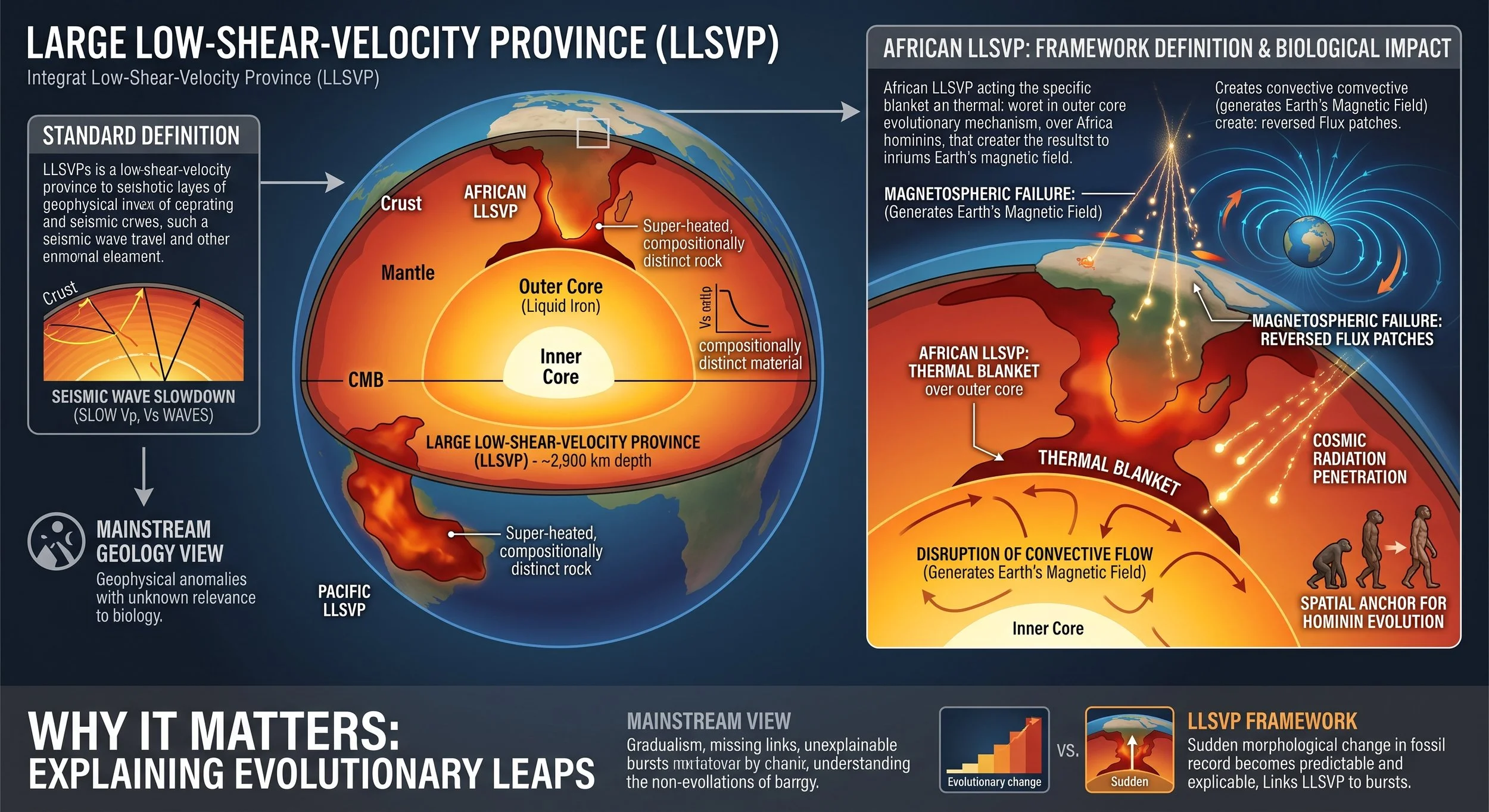
Large Low-Shear-Velocity Province (LLSVP)
Standard Definition:
A massive, dense region of super-heated rock located at the Core-Mantle Boundary (CMB), roughly 2,900 kilometers beneath Earth's surface. Seismic waves travel more slowly through these regions, indicating they are compositionally distinct from surrounding mantle material. Two primary LLSVPs exist: one beneath Africa and one beneath the Pacific.
Framework Definition:
The African LLSVP is the deep-earth engine of biological variation. It acts as a thermal blanket over the outer core, disrupting the convective flow of liquid iron that generates Earth's magnetic field. This disruption creates localized weak spots—Reversed Flux Patches—where the magnetosphere fails, allowing cosmic radiation to penetrate to the surface. The African LLSVP is the spatial anchor for hominin evolution.
Why It Matters:
Mainstream geology treats LLSVPs as geophysical curiosities—interesting for understanding mantle dynamics, but irrelevant to biology. This framework positions the African LLSVP as the primary driver of evolutionary leaps. Without it, the "missing links" remain missing. With it, the pattern of sudden morphological change in the fossil record becomes predictable and explicable.
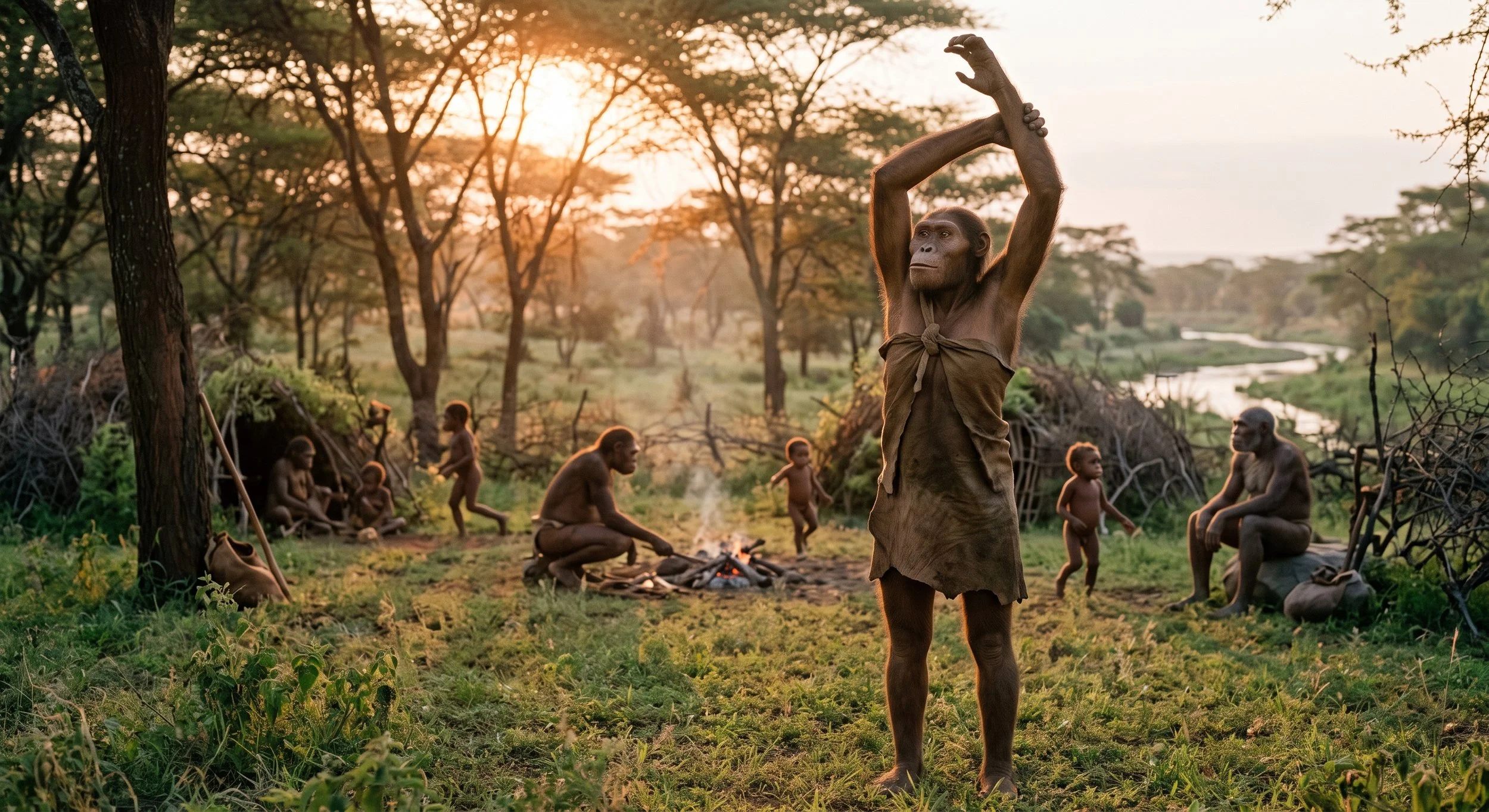
Amara's Story: A glimpse into the life of a woman who lived 3.2 million years ago
This is Amara. She is an Australopithecus woman who lived 3.2 million years ago in the woodlands and grasslands of what is now Ethiopia. Mainstream anthropology often compares her to modern chimpanzees or dismisses her as a primitive "missing link" caught between the ape and human worlds.
I see her differently. Amara and her people were intelligent and resourceful, living fully human lives in their own right. They lived in organized communities, built shelters protected by thornbush fences, and passed down knowledge across generations. Instead of the naked, ape-like depictions standard in mainstream paleoart, Amara wears a practical hide garment knotted at the shoulder to protect her skin from the sun and wind.
Her body was perfectly adapted to her environment. She stood a little over four feet tall with a sturdy bipedal stance, yet she retained longer arms and curved fingers suited for climbing the fruit trees that grew along the edge of the woodland.
Amara’s world was on the brink of a profound change. In my new series, I am exploring her deep history and the cosmic, deep-earth geophysical engine—the African Large Low-Shear-Velocity Province—that drove the sudden evolutionary leaps of our ancestors.
Join me as we rethink the story of human origins and dismantle the assumptions that have shaped the mainstream narrative for over a century.
Before the Story
I want to tell you a story. It is a story about an Australopithecus woman named Amara, who lived 3.2 million years ago in the woodlands and grasslands of what is now Ethiopia. She was a hominin but anthropologists like to compare her to modern chimpanzees. She was a member of the lineage that would eventually produce every human being alive today so I don’t think it is accurate or appropriate to compare her to chimpanzees.
The mainstream tells us that Australopithecus was a primitive creature, caught between the ape world and the human world. They want to make us believe Australopithecus was a missing link on the long road of evolution between our common ancestor with chimpanzees and us. I do not see it that way. I see Amara and her people as fully human in their own right, living in communities, building shelters, raising families, and adapting to their world with intelligence and resourcefulness.
Amara lived in a world that was very different from the one we inhabit. It was a world of ancient animals and shifting climates, a world that was on the brink of profound change. I have spent years reading the scientific literature on human origins. I have studied the fossil evidence, the archaeological evidence, and the genetic evidence. And I have come to see Amara and her people in a way that differs from the mainstream narrative.
This is the first in a series of posts that will explore the deep history of humanity. I will share Amara's story, and the stories of the people who came after her. I will explain the evidence that supports my interpretation. And I will challenge the racist assumptions that have shaped the mainstream narrative for over a century.
But first, let me introduce you to Amara. Let me show you her world. Let me help you see her as a person, not a specimen.
Amara’s Story
The morning light filtered through the acacia trees and cast long shadows across the ground where Amara's community had built their camp. She woke before the others, as she often did, and lay still for a moment beneath the hide that covered her, listening to the sounds of the woodland coming alive around her. Somewhere beyond the thornbush fence that surrounded the camp, a group of baboons were beginning their daily search for food, their calls carrying across the valley in sharp bursts that echoed off the distant hills. Amara pushed back the covering and sat up, the cool air raising bumps on her medium brown skin. She reached for the hide garment that she wore during the day and wrapped it around her torso, securing it with a knot at her shoulder. The garment was simple, practical, and it protected her from the sun and the wind. Around her, the other members of her community were beginning to stir. She could hear the soft sounds of movement from the nearby dwellings, the murmur of voices, the cry of a child. Amara stood and stretched, feeling the strength in her arms and the familiar balance of her upright stance. She was not tall by modern standards, perhaps a little over four feet, but her body was sturdy and well adapted to her life in the woodlands. Her arms were long, longer than her legs, and her fingers were curved, suited for grasping branches when she climbed. She would climb today, she knew, to gather fruit from the trees that grew along the edge of the woodland. But first, she would join her community for the morning meal, and they would talk about the day ahead, and they would plan where to go and what to do. This was the rhythm of her life, the pattern of her days, and it was a life that had been lived by her people for millions of years.
Amara's Morning
She stepped out of the dwelling and into the open space at the center of the camp, where the embers of last night's fire still glowed faintly in the hearth. A woman named Sina was already there, crouched beside the fire and feeding it small twigs to bring it back to life. Sina looked up as Amara approached and offered a quiet greeting, a soft sound that carried warmth and familiarity. Amara returned the greeting and knelt beside her, holding her hands out toward the growing flames. The heat felt good against her skin, which was cool from the night air.
Other members of the community were emerging from their dwellings now, and the camp was filling with the sounds of morning activity. Children ran between the structures, chasing each other and laughing, their high voices cutting through the deeper tones of the adults. An older man named Turo sat on a flat stone near the edge of the camp, his eyes half closed as he soaked in the first rays of sunlight. He was one of the oldest members of the community, and his knowledge of the woodland was vast. He knew where the fruit trees grew and when they would be ripe, where the bees built their hives, where the streams ran shallow enough to cross. The younger members of the community often sought his advice, and he was always willing to share what he knew.
Amara rose from the fire and walked to the edge of the camp, where the thornbush fence marked the boundary between the familiar space of her home and the wild woodland beyond. She stood there for a moment, looking out at the trees that stretched away into the distance. The woodland was dense in places, with tall trees whose branches formed a canopy that filtered the sunlight into soft green shadows. In other places, the trees gave way to open patches of grassland where the sun beat down directly on the earth. It was a landscape of contrasts, and Amara knew it well. She had spent her entire life learning its rhythms, its dangers, its gifts.
Today, she would climb. The fruit on the trees at the eastern edge of the woodland was ripening, and she wanted to gather as much as she could before the other animals got to it. She would take some of the younger members of the community with her, the ones who were old enough to climb but young enough to still be learning. She would teach them which trees to choose, how to test the branches before putting their weight on them, how to reach the fruit without falling. This was how knowledge was passed from one generation to the next, not through formal instruction but through shared experience, through the simple act of doing something together.
She turned back toward the camp and saw that the others were gathering around the fire, where Sina had begun to prepare the morning meal. There was a pile of tubers and nuts that had been gathered the day before, and a few pieces of meat left over from a recent hunt. It was not a large meal, but it would be enough. The community would eat together, and then they would go their separate ways for the day, some to hunt, some to gather, some to tend to the young or the old. In the evening, they would return to the camp and share what they had found, and the cycle would begin again.
Amara walked back to the fire and sat down with the others. She took a piece of tuber from the pile and bit into it, tasting the earthy sweetness. Around her, the community was talking and laughing and eating, the sounds of their voices blending together into a familiar music. She felt the warmth of the fire on her face and the solid ground beneath her, and she felt at home. This was her community, her family, her world. And she was grateful for it.
Amara's World
The woodland where Amara's people lived was not the dense, closed-canopy forest that we might imagine when we think of the African past. It was a grassy woodland, a mosaic of trees and open spaces that stretched across the floodplain of a great meandering river. The river had carved its path through the landscape over countless millennia, depositing layers of mud and silt that nourished the soil and supported a rich diversity of plant life. Sizeable trees grew along the riverbanks and in the patches of woodland that dotted the plain, their roots reaching deep into the moist earth. Between the trees, grasses and low shrubs covered the ground, creating a landscape of greens and browns that shifted with the seasons.
The climate of Amara's world was warmer and more humid than the arid Afar region of today. The mean annual temperature hovered around 26 degrees Celsius, and the coldest month rarely dipped below 24 degrees. Rainfall was highly seasonal, with a strong summer monsoon that brought between 300 and 800 millimeters of rain each year. The total annual precipitation was roughly 500 millimeters, about twice what the region receives today. The rains transformed the floodplain into a lush, green landscape during the wet months, filling the river channels and creating shallow lakes and wetlands where water birds gathered and hippopotamuses wallowed. During the dry months, the grasses turned golden and the smaller streams shrank to muddy pools, but the great river continued to flow, a lifeline for every creature in the valley.
The animals that Amara knew were not the same as the animals that live in Africa today. The antelopes and gazelles that grazed on the floodplain belonged to species that have long since gone extinct. There were large, pig-like creatures called Nyanzachoerus and Notochoerus, with sprawling tusks and bulky bodies, rooting through the vegetation for tubers and roots. There were early elephants, ancestors of the modern African elephant, whose tusks were shorter and whose ears were smaller. There were three-toed horses called Hipparion, distant cousins of the modern horse, browsing on the shrubs and grasses. And there were rhinoceroses, including an early species called Ceratotherium praecox, whose descendants would eventually become the white rhinoceros.
The predators of Amara's world were formidable. Among the most terrifying was Homotherium, a saber-toothed cat with long, serrated canine teeth and powerful forelimbs built for grappling with large prey. There were also hyenas, not the scavengers that we know today, but large, powerful hunters called Crocuta venustula, who competed with the saber-toothed cats for the same prey. And there were giant otters, Enhydriodon dikikae, creatures the size of modern lions, who lived along the rivers and lakes and hunted fish and small mammals. These predators were a constant danger to Amara and her community, and the thornbush fence around their camp was not merely a convenience but a necessity for survival.
The monkeys and baboons that Amara saw were not the modern species that we know today. The baboons belonged to an ancient genus called Theropithecus, which is represented today by only one living species, the gelada of the Ethiopian highlands. The Theropithecus that lived alongside Amara were large and powerful, with massive jaws and teeth adapted for eating grasses and seeds. There were at least two species present, including Theropithecus oswaldi and Theropithecus darti, and they were among the most abundant primates in the landscape. They lived in large troops, foraging together on the open grasslands and retreating to the trees for safety at night. Their calls, a deep, booming chorus, would have been a familiar sound to Amara's people, a sound that signaled the presence of other creatures sharing the same world. There were also smaller monkeys, including Parapapio, a primitive baboon-like creature, and Cercopithecoides kimeui, a large colobine monkey that fed on leaves and fruit in the woodland canopy.
Amara's people also had cousins in the broader hominin family who lived in the same region. There were the robust australopiths, whom they called the Robust Ones, with their massive jaws and enormous teeth, adapted for chewing tough plant materials. They shared the landscape with Amara's species, sometimes competing for food, sometimes avoiding each other, but always part of the same extended family. The forests and woodlands of the Afar were home to multiple species of hominins, each with its own way of life, its own rhythms and routines, its own place in the web of life that connected them all.
The chimpanzees and gorillas that we know today were not part of Amara's world. Their ancestors, the proto-chimpanzee and proto-gorilla lineages, had diverged from the hominin lineage millions of years earlier, but their fossil remains from this period are virtually absent from the record. Paleontologists have found no convincing fossils of early chimpanzees or gorillas in the Pliocene deposits of East Africa, and the reason may be that these apes lived in the dense rainforests of west and central Africa, environments where fossils do not easily form or survive. The dry, open woodland of the Afar was not their home, and they were not Amara's neighbors.
The world that Amara inhabited was a world in transition. The climate was becoming drier, the grasslands were expanding, and the forests were shrinking. The great river still flowed, but it carried less water than before. The animals that depended on the woodland were slowly being replaced by animals that preferred the open savannah. And Amara's people, with their upright stance and their clever hands and their complex communities, were adapting to the changing landscape in ways that would shape the future of their lineage.
Amara's Day
The sun had climbed higher now, and the camp was fully awake. Amara walked with Sina and two of the older children toward the eastern edge of the woodland, where the fruit trees grew thickest. Each of them carried a long stick, cut from a young acacia and hardened over fire, with a sharpened point at one end. These sticks served many purposes. They could be used to dig for tubers, to knock fruit from high branches, to probe the mud of the riverbank for hidden roots, and, if necessary, to drive off a predator that came too close. The people of Amara's community had been making and using such tools for as long as anyone could remember, though they did not shape stone into knives or scrapers the way their descendants would. Their tools were simple, but they were effective, and the knowledge of how to make them was passed down from one generation to the next with care.
As they walked, Amara kept her eyes moving across the landscape. She knew this woodland the way she knew her own hands. She knew which trees produced the sweetest fruit and when the fruit would ripen. She knew where the ground was soft enough to dig for tubers and where it was too rocky. She knew the tracks of the animals that shared this world with her people, and she could read them like a story. A set of antelope tracks in the mud told her that a herd had passed through recently. A pile of dung told her that a rhinoceros had been nearby, perhaps an hour before. A scattering of feathers told her that a hawk had caught a bird in the tall grass. The landscape was a book, and Amara had learned to read it.
The predators of this world were never far from her thoughts. During the day, the great cats and the hyenas were cautious. They rarely attacked a group of hominins who were alert and armed with sticks. The people were not easy prey. They walked upright, which made them look larger than they were. They carried weapons. They stayed together. The predators had learned to respect them, just as the people had learned to respect the predators. It was a relationship of mutual caution, a balance that both sides understood.
At night, however, the balance shifted. The darkness gave the predators an advantage, and the people retreated behind their thornbush fences, where fires burned through the night to keep the hunters at bay. Sleep was never entirely peaceful. There were always sounds in the darkness, always the sense that something was moving just beyond the firelight.
The river and the lakes were a source of food, but they were also a source of danger. The water was home to crocodiles, huge reptiles that could drag a person under in an instant. There were also hippopotamuses, massive animals with tusks and tempers, who lived in the shallows and could overturn a small boat or crush a person with a single bite. The people of Amara's community probably did not swim. Their bodies were not built for it, and the water was too dangerous. But they were resourceful. They fished from the shallows, using their hands to catch small fish in the quiet pools, and they gathered shellfish and water plants from the muddy edges. They knew which parts of the river were safe and which were not. They knew the habits of the crocodiles and the hippos, and they avoided the places where the animals gathered.
The children who walked with Amara were learning all of this. They watched her as she chose a tree and began to climb, her curved fingers finding purchase on the rough bark. They watched her as she tested a branch before putting her weight on it, a habit she had learned from her own mother. They watched her as she shook the branch and sent a shower of ripe fruit tumbling to the ground. The children gathered the fruit and put it in the hide bags they carried over their shoulders. They were learning the same lessons that Amara had learned, passed down through countless generations. And one day, they would teach these lessons to their own children, and the knowledge would continue, carried forward through time like a thread that connected the past to the future.
Afterward - A Note
This is a work of imagination, but it is grounded in the fossil and archaeological evidence. The environment, the animals, the tools, the shelters, the community structure, all of it is based on what we know from the scientific record. Where the evidence is silent, I have used my best judgment to fill in the gaps, always with an eye toward what is plausible and what respects the humanity of the people I am describing.
In the posts that follow, I will explain the evidence in more detail. I will introduce the African Large Low-Shear-Velocity Province and the Reversed Flux Patches it generates. I will explain how cosmic radiation penetrates the atmosphere during geomagnetic excursions and how it damages DNA. I will show you how the fossil record documents the sudden appearance of new phenotypes during radiation windows. And I will argue that the framework I am presenting explains the pattern of evolutionary leaps in ways that the mainstream models cannot.
I will also dismantle the racist pseudoscience that has infected anthropology for centuries. I will expose the skull collectors and the eugenicists who founded the discipline. I will show how their assumptions continue to shape the questions that researchers ask and the conclusions that they reach. And I will argue that the phenotypes we recognize today are recent mutations, not ancient adaptations.
This is a big project. It will take time to lay it all out. But I am committed to doing it right. I will present the evidence clearly and honestly. I will acknowledge the limits of my knowledge. And I will change my mind if the evidence demands it.
Thank you for reading. I hope you will join me on this journey.