The Provocative Parrhesiatic Polymath
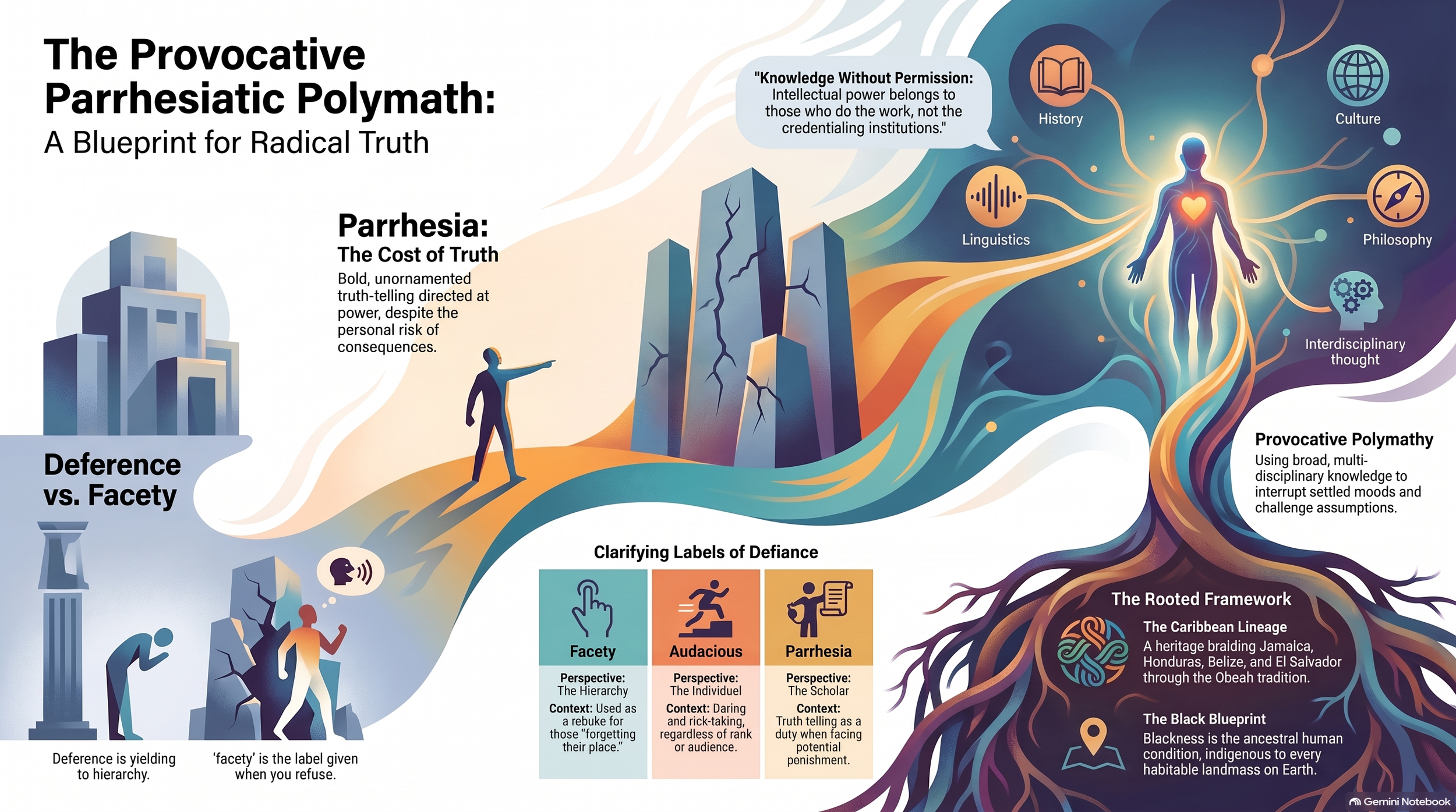
There is a word in Jamaican patois that gets used to put people back in their place. The word is facety. You hear it aimed at a child who talks back to an elder, at a young woman who questions a man twice her age, at anyone whose mouth has moved ahead of the position they were assigned. The word carries the flavor of facetious, and it lands as a rebuke, a way of saying that the person speaking has forgotten where they belong. What the word describes depends entirely on who is holding the power to apply it. The same sentence that gets a child called facety gets a professor called incisive. The behavior stays constant while the label swings, and the swing tracks the hierarchy, never the words.
Start there, because that single word holds the whole architecture of what a Provocative Parrhesiatic Polymath is and why the phrase carries weight.
Deference
Deference is the act of yielding to another person's judgment, authority, or preference, granting them the higher position in a hierarchy. It can be offered willingly, as a form of respect for someone whose wisdom you value, or it can be extracted under pressure as a form of submission. Deference decides who speaks, who decides, and whose version of events carries weight. It is the currency of hierarchy, the thing that gets traded whenever one person holds power over another. When someone demands deference, they are asking you to lower your voice and accept their placement of you beneath them.
Facety
Facety is what the hierarchy calls you when you decline to offer the deference it expects. It is a Caribbean word, Jamaican in its most common usage, describing someone bold, impudent, cheeky, speaking above their station. The important thing about the word is who gets to use it. Facety is an accusation made by the person whose authority is being questioned, a way of naming the challenge itself as the offense. The behavior being described is the same behavior that others call courage, integrity, or leadership. The label depends on where you sit on the ladder, and the people at the top are the ones who write the label.
Audacious
Audacious means daring, bold, willing to take risks, willing to defy convention. The Latin root audax carries the sense of boldness that can shade into recklessness, and the English word keeps both possibilities alive. Audacity gets praised when the risk succeeds and criticized when it fails. It differs from facety in an important way. Audacity describes the quality of the act itself, while facety describes the act from the perspective of someone who feels challenged by it. You can be audacious in a room of equals, in front of a crowd, or entirely alone. You can only be facety in relation to someone who believes they outrank you.
Parrhesia
Parrhesia is a Greek word meaning frank speech, and Michel Foucault built an entire lecture series around it in the 1980s. The parrhesiastes is a person who speaks the truth boldly, without ornament, and at genuine personal risk, addressing someone more powerful than themselves. The practice has four parts. The speaker tells the truth. The speaker faces danger for telling it. The truth is directed at someone with the power to punish. The speaker acts from duty rather than from self-interest. Parrhesia sits at the opposite end of the spectrum from flattery, and it differs from ordinary honesty because it costs something. A person who tells the truth in safety is honest. A person who tells the truth knowing it will bring consequences is practicing parrhesia.
Provocative
Provocative comes from provocare, to call forth, and it describes anything designed to stir a response, to challenge an assumption, to interrupt a settled mood. Provocation invites reaction. It creates movement in a space that had gone still. The word gets used as criticism when the reaction is anger and as praise when the reaction is thought. A provocative speaker refuses to let the audience remain comfortable, treating that discomfort as the beginning of attention rather than a reason to retreat.
Polymath
Polymath comes from the Greek polymathēs, meaning having learned much, and it describes a person whose knowledge and competence spans a wide range of fields rather than deepening in one narrow channel. The older English term is polyhistor, and the tradition runs from Aristotle through Ibn Khaldun through the scholars of the Renaissance. A polymath works across disciplines because the questions that matter refuse to respect the boundaries between them. Geology answers questions about biology. Astronomy answers questions about climate. The person who follows those threads ends up holding knowledge from many rooms in the same hand.
The Arc
There is a sequence running through these words, and it describes a specific kind of person. The hierarchy demands deference. That person declines to offer it. The people who expected it call the refusal facety. The person recognizes it in themselves as audacity. The Greeks, who understood the practice better than anyone, called it parrhesia. The effect on the room is provocation. The breadth of what that person brings to the moment, the range of evidence and history and geology and biology drawn on to make the point land, is where the polymath enters.
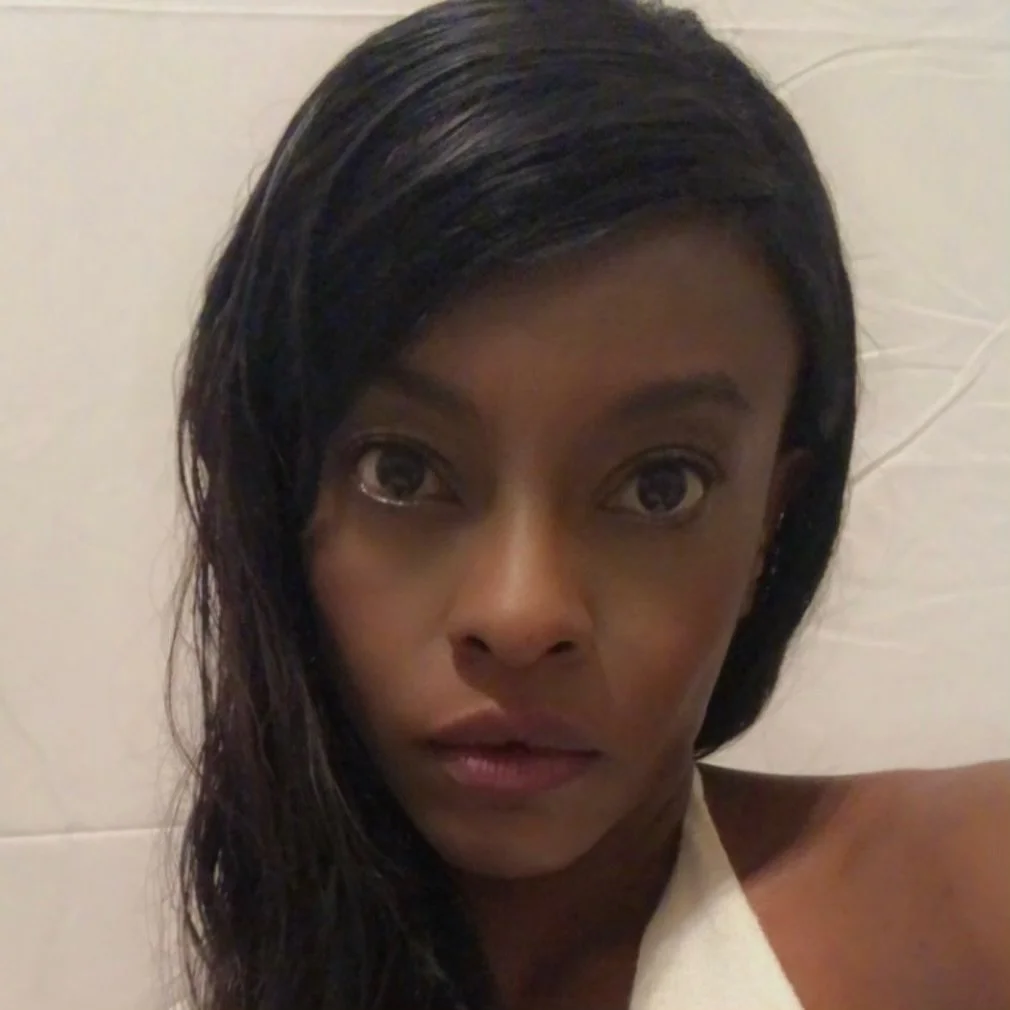
My name is Andrea Brooks, and I am a Provocative Parrhesiatic Polymath.
The Lineage
I was born in Boston in 1980 to parents who were both born in Honduras. My mother’s mother came from Jamaica, born around 1923, and she spoke with that thick Jamaican patois accent, the same accent that gave me the word facety. My mother’s father was born on the Bay Islands of Honduras in 1893 and his roots reach back to the Cayman Islands. My father’s father was from Belize, born around 1911. My father’s mother was born in Honduras but bother of her parents emigrated to Honduras. Her mother was from El Salvador and carried no Black ancestry at all. Her father came from Jamaica and he was an Obeah man.
That is four territories braided into two generations. Jamaica, the Bay Islands and the mainland of Honduras, Belize, and El Salvador, with a Cayman thread running underneath. I identify as Black Hispanic but I am Caribbean through and through.
I want to be precise about something, because the imprecision has done damage for a long time. Obeah is a Caribbean tradition. It formed in the Caribbean, from Caribbean conditions, with its own lineage and its own logic. It is not a surviving fragment of Africa carried across the water in a suitcase. Caribbean scholars have argued this for decades against the reflex that treats every Black spiritual practice as an African remnant. My great-grandfather practiced a tradition that the British colonial order criminalized for two centuries, precisely because it carried authority outside the church and outside the colonial state. That is the inheritance I received, and it shaped how I understand the world long before I had words for it.
Black does not mean African. That conflation is one of the laziest moves in the whole discourse, and it erases Melanesians, Aboriginal Australians, the Andamanese, the Semang, the Aeta, the Black populations of South Asia, and the deep Black lineages of the Americas and the Caribbean. Dark skin is the ancestral human condition. Dark-skinned peoples are indigenous to landmasses across the entire planet. Blackness is the blueprint for humanity, and I state that as my conviction and as the framework I am building on. I hold that Black people are autochthonous to every habitable landmass on this planet, and I hold that anything other than Black is recent, arriving after the Laschamp geomagnetic excursion roughly 41,000 years ago. Those are positions I take deliberately, and I mark them as positions so my listeners know exactly which ground they are standing on when they stand with me.
My surname is Brooks, and I know enough of the history to know that we did not get our last name from enslavers. Some of my ancestors were Indigenous Black Europeans. I will explain the history of Black Indigenous Europeans in future posts. The assumption that a Black surname must trace to a slaveholder is colonial nonsense that deserves the scrutiny I am giving it. I will not argue the point further here. The record is still being uncovered, and I am uncovering it.
The Education
I never earned a degree but I took a lot of university classes. Some of them were at Brandeis and Harvard, and some were at Mass Bay and UMass. I went where the material was and took what I needed. I have been operating as if knowledge belongs to anyone willing to do the work, which is a Caribbean tradition as much as it is a personal conviction. My grandmothers and great-grandfathers did not wait for permission to think, to heal, to lead, or to speak. They simply did it, and the colonial state called it Obeah and criminalized it. I inherited both the practice and the refusal.
The Motherhood
I am the mother of five amazing people. I homeschooled my children when they lived with me, and I taught them to read when they were three and four years old depending on their readiness. The decision to homeschool my kids came from my love for education and my desire to ensure they had a solid foundation to grow on. The institutions that decide who gets to learn and who gets to be called educated have a long history of getting it wrong, and I was not going to hand my children over to that judgment before they had a chance to become themselves. They learned to read early because reading is power, and power is something you give your children directly rather than waiting for a system to distribute it.
The Refusal
I do not believe in social hierarchies, and I push back on them harshly because I have watched what they do to people. The hierarchy demands deference. It calls the refusal facety. It writes the refusal into the record as a defect of character rather than a defect of the system. I am a woman, I am Black, I am Caribbean, I was born in Boston to Honduran parents, and I am not interested in any arrangement that places me beneath anyone. I was born into a society that decided some people are above others based solely on the accident of birth.
The Spirituality
I was raised Christian and I rejected it early. I am deeply spiritual but I am not religious. I guess I am more like my great-grandfather, the Obeah man. My spirituality is something I am willing to share, and I have been developing it into a framework that branches off a constructed language I built. That is another long story, and it belongs in its own space.
You can learn more about Parlexian, my constructed language here. And you can learn more about my cosmology Parlexian and join my spiritul learning community Ama Shonuma here.
The Land
I was born in Boston, and that matters more than I understood for a long time. I grew up on land whose original people were pushed out and renamed, and I could feel the spirit of the place speaking before I had language for what was speaking. The Eastern Woodlands People are Black like me. They always had a connection to the Caribbean because we are all coastal people, and the water moved us in every direction, including the direction that carried so many of them into slavery on Caribbean islands. I am unerasing their history because it is my history too, and the record is fuller than the standard story admits.
The Work
So here is what I am doing. I am telling the deep human story from the ground up, following the evidence where it leads, refusing the frameworks that were built to keep people like me in the lower rungs of a hierarchy. I am telling the story of Lucy, and early Australopithecus afarensis person from over three million years ago who walked upright and used tools and built what she needed. I am telling the story of Java Man, a Homo erectus person whose bones were dug out of the ground by convict labor while a colonial doctor named him an ape-man.
I am telling the story of how Homo erectus survived for over a million years. I am also going to explore the populations of people that reached the Americas long before the acidic soils took the evidence of their bodies. I am telling the story of Black people as the blueprint for humanity. We were present on every landmass before any other phenotype existed. I am telling this story in my own voice without asking permission from the people who spent centuries insisting the story was something else.
I am Andrea Brooks. This is The Polymath's Parrhesia Blog. I intend to speak plainly, and I intend to say what I actually think, and I intend to do it knowing exactly what the hierarchy will call it when I do.
