Why I Went Looking for the Ingleses
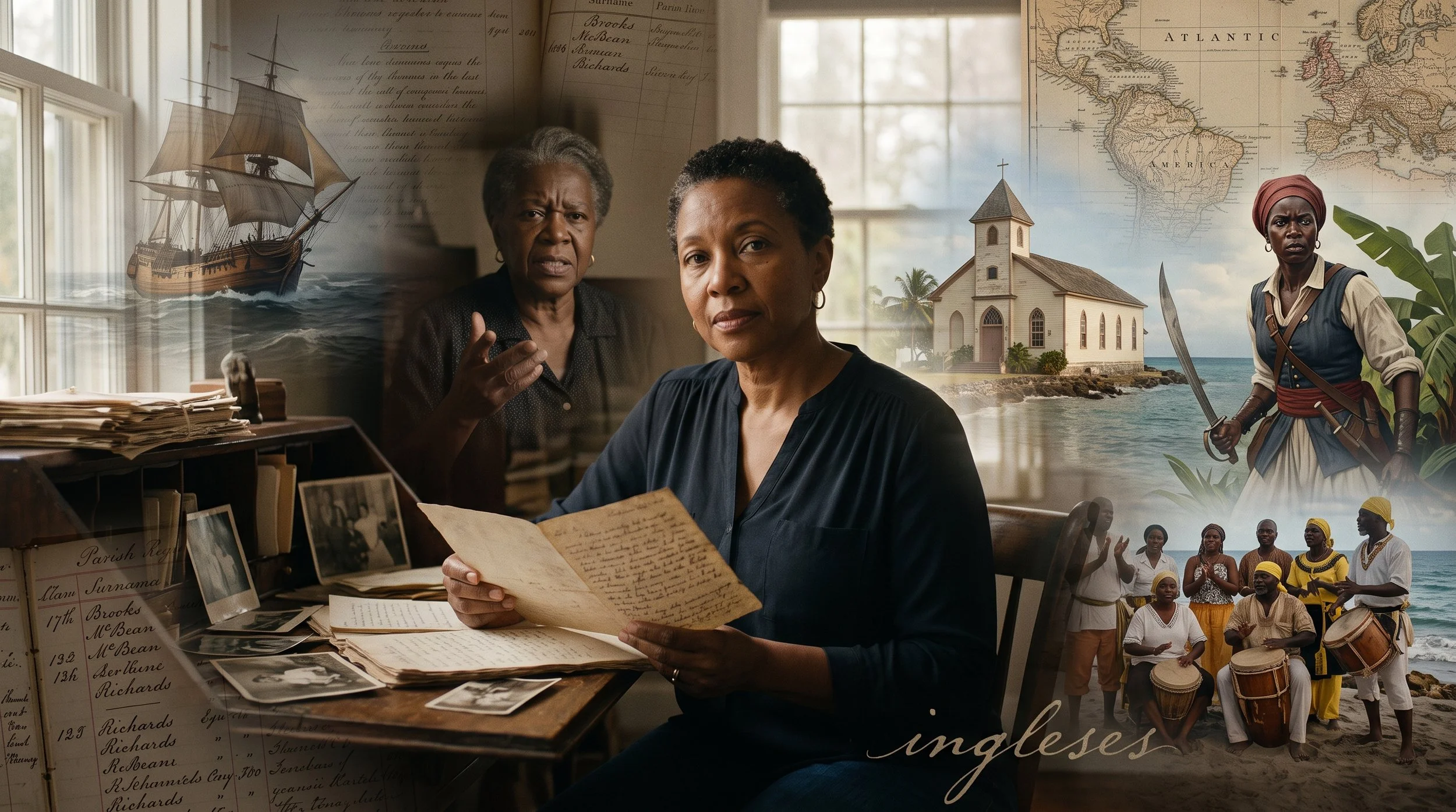
There is a word my mother uses for us, and she uses it with a finality that forecloses further discussion. Ingleses. The word is Spanish, and it means "English." Her diminutive version, inglesitos, means something closer to "little English ones," and she says it the way a person names a family trait that has been passed down so long that no one remembers where it came from.
When I told my mother I suspected we carried Garifuna ancestry, she pushed back hard, insisting that her father had spoken Garifuna but he also spoke many other languages and that our family's identity was settled. Ingleses, she said. That word, and the resistance that came with it, stayed with me for years.
I have five children, and two of the three fathers are Garifuna. When I began digging into my own lineage, I half expected to find that I was Garifuna myself. I confess I wanted it. My mother and her Jamaican mother had always spoken about the Garifuna with a contempt I found repellent, and that contempt, rather than pushing me away, drew me toward the people it was aimed at.
The Garifuna are a Black Indigenous people of the Americas who held onto their language and their ceremonies through centuries of colonization, and their survival is one of the great refusals in Caribbean history. Their language is Arawakan which is indigenous to the Americas, not African. Their origins lie in the islands and along the Central American coast. I wanted to belong to a story like that.
My mother's father was born on the Bay Islands of Honduras in 1893, when his mother was sixteen years old. No father is named on the record. My mother says he spoke Garifuna. That detail has never left me, and I still suspect that somewhere in the tangled branches behind him there is Garifuna ancestry.
But something else was nagging at me, and it had to do with the surnames.
A friend of mine from Brandeis, a Black Jamaican named James McBean, greeted me the first time we met with a question I did not understand. The first thing he said to me was, "You look like a Maroon. Are you Maroon?" I still get chills when I think about it. At the time, I had no idea what he meant. Now I know a lot more about the Jamaican Maroons and about Queen Nanny. She was an Obeah practitioner and a fierce warrior who fought the British and won. She beat them so badly that they were forced to sign treaties with the Maroons. Queen Nanny is one of the ancestors who guides me.
Something that always stood out to me was James’ surname. McBean is Scottish. If the standard story were true, that Black people simply took the surnames of the people who enslaved them, then every person on a given plantation should carry the same name, and James should have carried the name of a Jamaican planter rather than a Scottish one. When I began pulling the registers, that uniformity never appeared. Names varied within families, across households, and across generations. The assumption that Black people received their surnames from enslavers is a colonial reflex, and the documents do not bear it out.
So I went looking, and what I found reframed everything I thought I knew about where we came from. Black people were present in Britain and Ireland and across Europe for centuries before the so-called transatlantic slave trade, and their presence was not confined to the servant class. They held land, paid taxes, and voted in local elections. When the state decided to remove them, it did so with proclamations and transportation orders that swept up the poor, the imprisoned, and the undesirable alongside them.
The 1600s saw a campaign of removal that sent thousands of English, Irish, and Scottish prisoners to Barbados, Jamaica, and the other islands, and Black Indigenous Europeans were among them. The records that documented this traffic called them prisoners, a label that erased where they came from and who they were. Other records from the same century described Black people as swarthy, tawny, and Moorish, words that carried the meaning of Blackness without using the word Black.
My family's surnames are Brooks, Green, Tennyson, Richards, Martin, and Iraheta. English, Welsh, Irish, and Basque. They are older than the plantation, and they are older than the trade that the standard story insists gave them to us.
My mother calls us ingleses which means English. That word is a memory, and it is a memory of a history that the records were built to obscure. It is the Caribbean memory of the prisoners who were shipped to the islands, of the Black Indigenous Europeans who were transported and enslaved and written out of the ledger, of the people who kept their own names when the system tried to take them.
This series is about the real history of the transatlantic slave trade. We were taught that Africans were captured and shipped across the Atlantic and enslaved in the Americas. They want us to believe that all of the Black people in the Americas today are descendants of people who were captured in Africa and trafficked across the Atlantic but that is a lie. The lie is told to obscure the real history of two distinct groups of Black people and deprive us of land rights. The two groups are Indigenous Black people of Europe and Indigenous Black people of the Americas.
You are probably already doubting the validity of what I am claiming so I will give you one piece of evidence to start with. When Columbus arrived in the Americas there was a distinction made between Black people from Africa and the Black people who were already here. Old Spanish and Portuguese records mention Negros de la Tierra which translates to Blacks of the Land and refers to the Indigenous Black people who had been in the Americas for thousands of years. They also mention Negros de Guinea which translated to Blacks of Guinea. Guinea is what they called Africa so they were basically saying Black people from Africa. I want you to remember that term for Africa, Guinea, because it will come up again when I tell the history of the Indigenous Black people of the Americas. Eventually I will tell the stories of both groups, Indigenous Black people of the Americas and Indigenous Black people from Europe, but I am going to start with my history first.
The story begins with the Black people who lived in Britain and Ireland in the 1500s, before the trafficking began. It moves through the proclamations of Elizabeth I and the transportation campaigns of Cromwell. It follows the ships to Barbados and Jamaica, and it traces the Black Irish, Black Scottish, and Black Britons who survived there and in Cayman. It examines the surnames that Black people kept, the names that were theirs, and the labels that the records used to hide them. It ends, for now, with the Garifuna, the Black Indigenous people of the Americas who are still here, and with my own family, and with the word ingleses. We will also examine the history of the Black Indians from Massachusetts where I was born and raised because that history feels very personal to me as well.
Back to what started this journey of exploration for me. My mother pushed back when I said Garifuna. She insisted we are ingleses. I am not going to argue with her. I am going to follow the records and the names and the history wherever they lead, and I am going to tell the story that the colonial archive tried to bury. The contempt for the Garifuna that I grew up hearing is itself a colonial inheritance, passed down through generations that did not know where it came from. The word ingleses is a memory of survival, and so is the Garifuna refusal to disappear.
This is why I went looking and I am going to share what I found. This is where the story begins.
Andrea Brooks is an independent researcher and writer challenging the racist foundations of anthropology, history, and science. She is the creator of the Parrhesia Project on Substack and Medium, the Polymath's Parrhesia Podcast, and the Rumble livestream series Let's Debunk the Bullshit. She writes about human origins, phenotypic diversity, and the erasure of Black Indigenous people from the historical record.