Article 1: Before the Removal: The Black Nobility of Indigenous Europe
The written record of Europe opens with Black people in it, and it opens with Black people at the top. The earliest named individuals in the British and Irish archives are Black people who held wages, land, and standing. The earliest images of named individuals are Black people in fine clothes. The earliest records of property, literacy, and civic participation include Black people by name. This is the baseline, and the story of what happened in the 1500s and 1600s is the story of how that baseline was dismantled.
The Terminology of the Records
Before going further, the reader needs to know the words that the records themselves used. These are the terms that appear in parish registers, wills, state papers, and court documents from the sixteenth and seventeenth centuries. They are not the words we use today, and understanding them is essential to reading the evidence correctly.
Swarthy
The Oxford English Dictionary defines swarthy as describing a person’s complexion or skin color as “(relatively) dark in colour; brown, olive-coloured, or tanned” . The word entered English in the 1570s, and the earliest recorded use, from 1572, is the phrase “swarthy blacke” . It comes from the Old English sweart, the same root that gives the Dutch zwart and the German schwarz, both of which mean black. When a record from the 1500s or 1600s describes someone as swarthy, it is describing a Black person.
Tawny
Tawny entered English in the fourteenth century from the Old French tané, meaning the brownish-yellow color of tanned leather . In colonial British English, the word came to mean “brown-skinned person,” a usage recorded from the 1650s . The phrase “tawny Moor” was used to distinguish a brown-skinned Moor from a “blackamoor,” and both terms referred to Black people .
Moorish
Moorish was a synonym for swarthy. The word “Moor” and “blackamoor” were used interchangeably with “Negro” and “Ethiopian” in the period to describe Black people. In his 1600 translation of Leo Africanus, John Pory described the “principall nations” of Africa as “the Africans or Moores, properly so called; which last are of two kinds, namely white or tawnie Moores, and Negros or black Moores” . The Moors were described in European texts of the period as Black, swarthy, or tawny in skin color.
Blackamoor
The word “blackamoor” is a compound of “black” and “Moor” . It was the name used by English people to describe dark-skinned people. In 1596, Elizabeth I’s privy council authorized the transport of “blackamoors” from the realm, and five years later a merchant complained that “great numbers of Negars and Blackamoors” had “crept into this realm” . The term was used in state papers, household inventories, and portraits.
These are the words that the English records actually used. When a clerk wrote “swarthy” or “tawny” or “blackamoor,” he was describing a Black person. The records did not use the word “African” in the way we use it today, and they did not distinguish between Black people from different parts of the world. They described skin color, and skin color meant Black.
The Original People of Europe
The earliest populations of Britain, Ireland, and Europe were Black. Cheddar Man, whose skeleton was found in Gough’s Cave in Somerset, lived about ten thousand years ago. When his DNA was sequenced in 2018, the results showed a man with dark skin. He belonged to the people who repopulated Britain and Ireland after the last ice age, and that population carried dark skin across the whole of Europe for thousands of years. La Braña 1, found in Spain, and Loschbour, found in Luxembourg, carry the same ancestry. These are not fringe findings. They come from peer-reviewed sequencing of ancient genomes, and they establish that the ancestral European population was Black.
The Roman period adds detail. The Ivory Bangle Lady, buried in York in the fourth century with jet and ivory bangles, glass beads, and a bone mount, was buried with the grave goods that mark high status. Skeletal analysis of her skull showed Black ancestral traits, and isotopic testing of her teeth indicated she grew up in a warm, coastal climate. She was a Black woman of high status in Roman York, buried with jet from Whitby and ivory from North Africa.
The medieval period preserved Blackness in its own way. Saint Maurice, the Roman soldier venerated across Europe, was depicted as a Black man in manuscripts and sculpture from the tenth century onward, and he became the patron saint of Magdeburg in Germany. The Arthurian tradition carried Morien, the Black knight, in a thirteenth-century Dutch romance, and the Black Madonnas of Europe, from Chartres to Montserrat, preserve a devotional tradition that centers a dark-skinned mother.
The Royal Households Were Black Households
Black Nobility of Europe
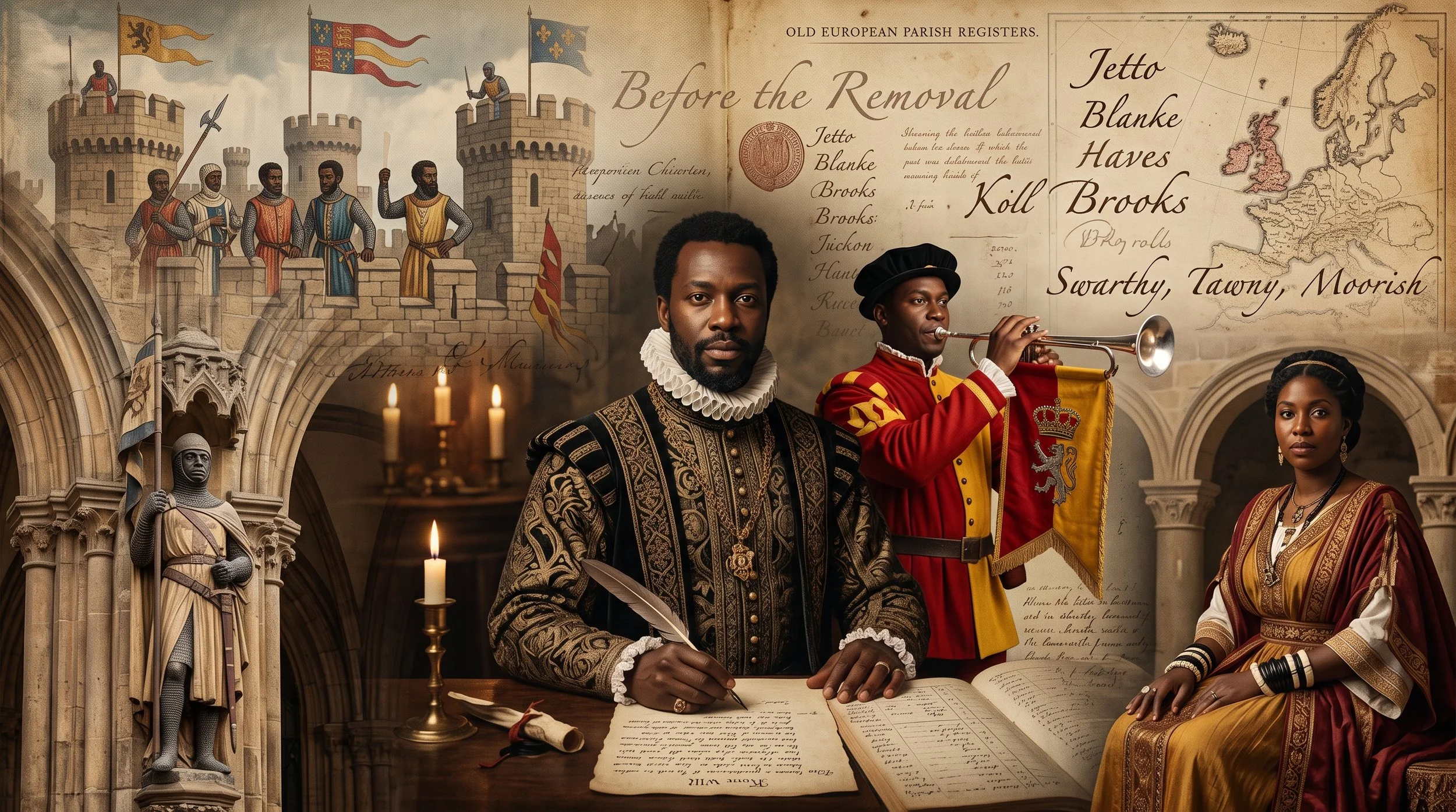
John Blanke is the first named Black person in the English royal record, and he was not a servant. He was a trumpeter to Henry VII and Henry VIII, paid at a rate above the standard for Crown service, honored at the funeral of one king and the wedding of the next, and recorded twice in the Westminster Tournament Roll of 1511, a sixty-foot manuscript held by the College of Arms. That image is the earliest portrait of a named Black person in Britain, and it shows a man in the livery of the court, mounted, in the ceremonial life of the kingdom. He petitioned the king for a pay raise and received it.
The Scottish court preserved the same pattern. James IV employed Black musicians and entertainers, and the Scottish Treasury recorded payments to Black troubadours throughout his reign. Two young women referred to as the Moorish lassies arrived at Edinburgh Castle in 1504 and lived as free people of the court. Catherine of Aragon arrived in England in 1501 with Black attendants in her household, and Black musicians and dancers performed at the court of Elizabeth I.
The Queen’s Own Mother
Anne Boleyn and Queen Elizabeth I
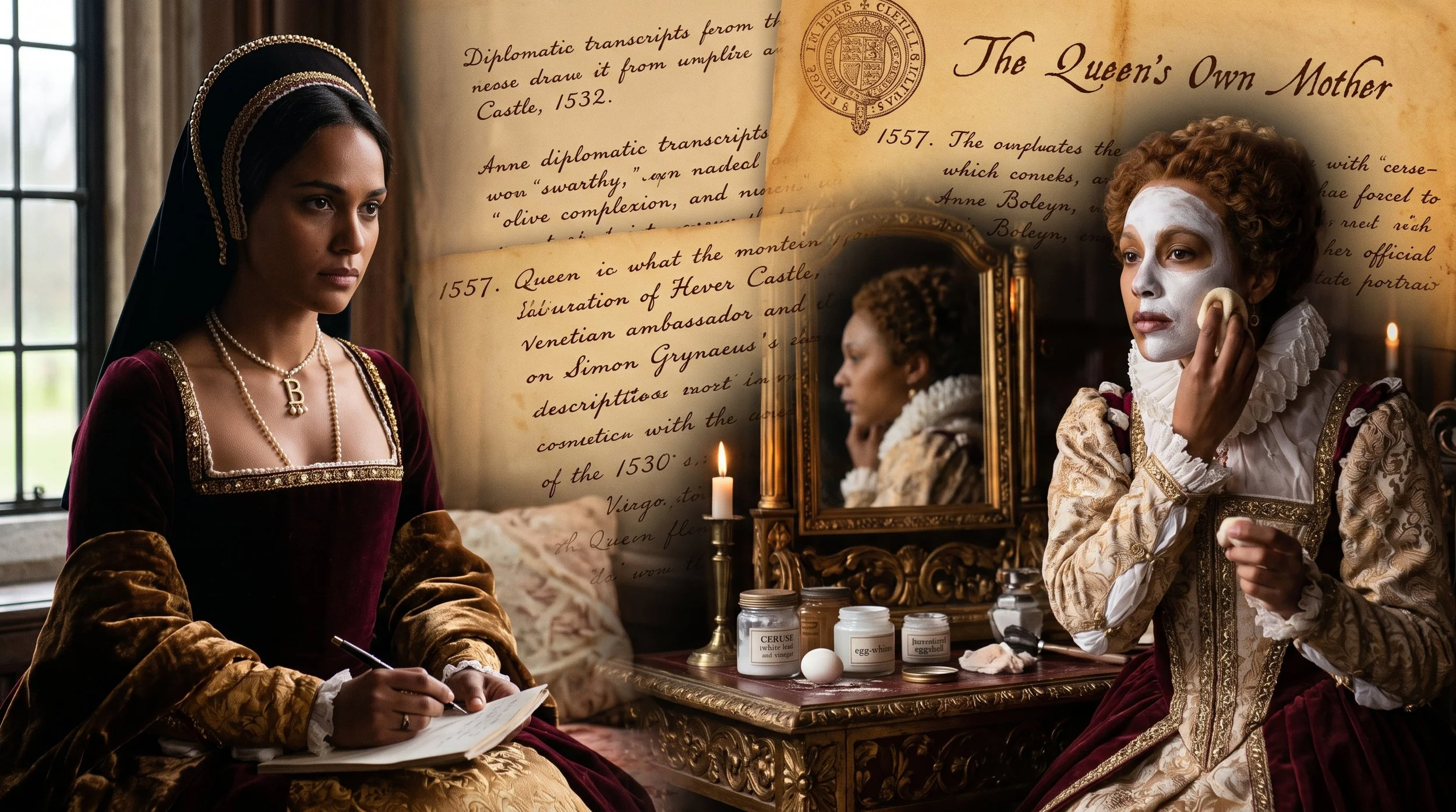
The removal did not happen from the outside against a population that had no connection to the throne. It happened from within a royal line that was itself described as Black. Anne Boleyn, the mother of Elizabeth I, was described by the Venetian ambassador who saw her in 1532 as having a swarthy complexion and eyes that were black and beautiful. Simon Gryneaus, a Swiss theologian writing in 1531, described her as being of a rather dark complexion. These were not hostile Catholic sources writing decades after her death. They were eyewitnesses writing during her lifetime. Anne Boleyn was a Black woman, and she was the Queen of England. Her daughter inherited that complexion.
Giovanni Michiel, writing to the Venetian Senate in 1557, described Elizabeth I as being tall and well-formed, with a good skin, although swarthy. The same description appears again in 1557, noting she had a beautiful hand and fine eyes, but that her skin was swarthy.
Elizabeth’s biographers have noted that she had a swarthy, ‘olive’ complexion like that of her mother, and that she made a habit of whitening it with a lotion made up of egg-whites, powdered eggshell, poppy seeds, borax and alum to make her face appear white and luminous. Later in life, she used ceruse, a paste of white lead and vinegar, which thinned her skin, rotted her teeth, and caused the hair loss visible in her later portraits. The ghoulish white mask was not her natural face. It was the face she manufactured to erase her mother’s.
The woman who issued the proclamations against the “Blackamoores” was herself the daughter of a woman described as Black. The woman who authorized the transportation of Black people out of England was herself trying to whiten her own skin to hide the Blackness she had inherited from her mother.
The Landowners
Henry Jetto held land in Worcestershire. He was baptised at St Martin’s Church in Holt in 1596, and the city records describe him as a Blackamoor. He held the rank of yeoman, which required land worth at least forty shillings and carried the right to vote in local elections. He wrote and signed his own will on 20 September 1626, and the document shows he left goods worth £17, 15 shillings, and 8 pence, the equivalent of more than £2,000 today. He was literate, propertied, and civic. He was a Black landholder in England.
The Visual Record
The statues and paintings that depict Black people in fine clothes holding gold cups are evidence, not curiosities. They survive across Europe, and they were altered.
Saint Maurice was a Roman soldier from Thebes, venerated across Europe, and from the tenth century onward he was depicted as a Black man in manuscripts and sculpture. The statue of him in Magdeburg Cathedral, carved in the thirteenth century, shows him as a Black knight in full armor, standing guard as the cathedral’s gatekeeper. He became the patron saint of Magdeburg, and German rulers adopted him as their patron. Later restorations and reproductions lightened him.
The Black Madonnas of Europe, from Chartres to Montserrat, preserve a devotional tradition that centers a dark-skinned mother. Some were darkened in devotion and later lightened in restoration. The practice of whitening Black figures in European art is documented, and it is one of the mechanisms by which the visual record was rewritten.
The tapestry known as Wild Men and Moors, made in Germany around 1440 and now held by the Museum of Fine Arts in Boston, depicts a battle between giant wild men clothed in forest products and the civilized defenders of a castle. The wild men have unkempt hair and beards and prominent fangs, and they attack with sticks and stones. The defenders of the castle are Black, and they fight with bows and arrows from a fortified position. Their king, queen, and princess watch from the keep while heralds call for assistance. The Black defenders inhabit the castle. The pale wild men come from the forest as forces of savagery.
In the Cantigas de Santa María, commissioned by Alfonso X of Castile in the thirteenth century, Cantiga 185 depicts three Black soldiers defending the castle of Chincoya against an attacking force. The miniature shows them in military garb, positioned on the walls, fighting to protect the fortress. They are defenders of institutional power, and the image places them inside the castle rather than outside it.
The Parish Registers and the Broader Record
Miranda Kaufmann documented over 360 Black people living in Britain between 1500 and 1640, and the majority are not recorded as having a master or mistress. The parish registers record Black people being baptised, married, and buried, and the subsidy rolls show Black property holders. The records that survive are a fraction of what once existed.
The medieval legends of Ireland preserved the memory of Black people who were there before the later arrivals. The Formorians, described as fierce sea-pirates with black skin and curly hair, are said to have arrived in Ireland in the first century BCE. The Black Fomorians, the Partholonians, the Nemedians, the Firbolgs, and the Tuatha De Danann all appear in the Irish origin traditions as peoples who inhabited the island before the Gaels.
Why This Matters
Black people were indigenous to Britain, Ireland, and Europe. They held land, paid taxes, voted, served in the households of kings, and were buried with the grave goods of high status. They were literate, propertied, and civic. They had names, and they kept them.
The pale-skinned populations that came to dominate Europe arrived in waves from the steppe, the Caucasus, and Siberia, and the societies they built were, for centuries, primitive in hygiene and literacy by the standards of the Black and Moorish civilizations they encountered. The Black people who were already here were the targets of a removal that began with proclamations and ended with transportation.
The removal did not begin in a vacuum. It began against a population that had been here for thousands of years, that held land, and that carried names. The names are the thread that connects John Blanke and Henry Jetto to the Brooks and Green and Tennyson families of Jamaica and Grand Cayman.
The next article follows the whitening of the art and the erasure of Black nobility from the written record.
Andrea Brooks is an independent researcher and writer challenging the racist foundations of anthropology, history, and science. She is the creator of the Parrhesia Project on Substack and Medium, the Polymath's Parrhesia Podcast, and the Rumble livestream series Let's Debunk the Bullshit. She writes about human origins, phenotypic diversity, and the erasure of Black Indigenous people from the historical record.

Andrea Brooks
